
The Light We Carry

As we sat down, admittedly very close to my due date, to discuss names for our third child, my husband, Jeremy, hesitantly said, “I know this is strange, but what about Tsohar as a name?”
Tsohar is a hapax legomenon, a super fancy term for a word that only shows up once in a text. This word appears only once in the entire Tanakh—the five books of Moses, the Prophets, and all the other writings. And its single appearance is in this week’s parashah, Noah. When God tells Noah to build the ark, God instructs him ,צֹהַר תַּֽעֲשֶׂה לַתֵּבָה—Make a Tsohar for the ark. Since this word only shows up once, the rabbis are not exactly sure what it means. One midrash shares a makhloket, a disagreement, between two rabbis. Rav Aba bar Kahana said it was a window, and Rav Levi said it was a gem that brought light into the ark. Either way, it was something that illuminated the ark. Noah is one of the earliest biblical stories I remember learning about, but never once had I thought about how dark it might have been inside the ark or how Noah, his family, and all the animals had light.
Tsohar is a light in the darkness, perhaps coming through a window or shining from a gem. I keep coming back to the image of this small source of light inside the ark, in the midst of the destruction, the fear, the uncertainty.
But the rabbinic imagination does not leave this light only for Noah. In his book Tree of Souls: The Mythology of Judaism, Howard Schwartz brings together teachings and midrashim from across the rabbinic tradition, tracing the Tsohar through each generation. The story begins with the primordial light of creation, back at the very beginning, in Bereshit, with God’s first act of creation, the utterance of יְהִי אוֹר, “Let there be light.” The primordial light of creation was mostly hidden away after Adam and Eve decided to eat from the Tree of Knowledge. But a small amount of this light was saved for them and placed in a gemstone, which was gifted to them as they sat outside the gates of the garden, unsure of what was to come. In a scary and dark world, it was a reminder of the light, the goodness of the garden, the closeness to God, and the holiness that still existed, even if it was now harder to find.
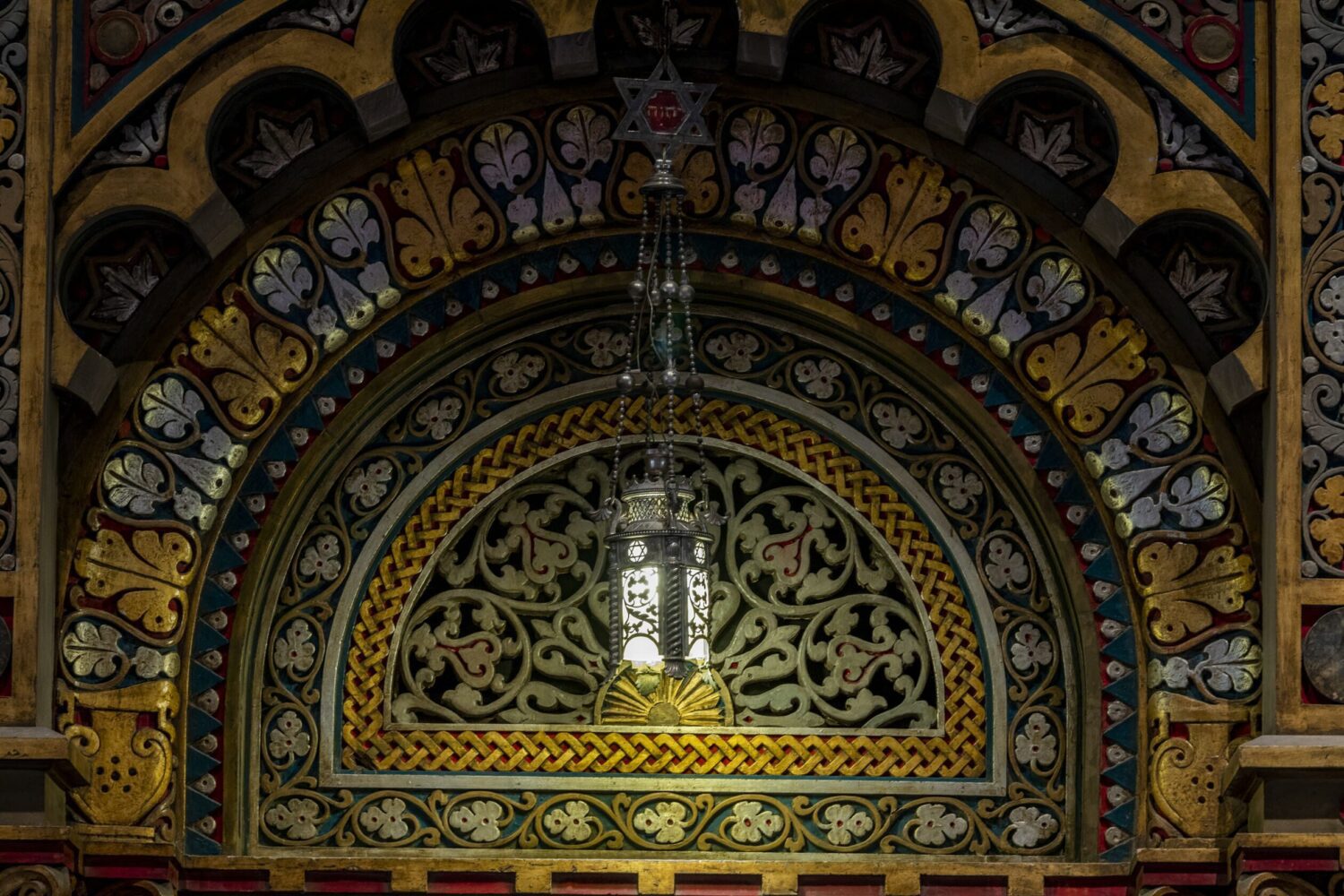
The midrashic sources continue following the Tsohar as it appears in each generation, from Adam and Eve to Seth, to Enokh, to Noah, to Abraham, Isaac, and Jacob, who gifted it to Joseph. Joseph used the gem to light up the pit his brothers threw him into. The gem ends up being placed on Joseph’s coffin and is later found by Moses when he takes Joseph’s bones with him out of Egypt. It is placed in the Mishkan, the traveling tabernacle, above the ark, as the ner tamid, the eternal shining light. It is the very light we now have above our arks, where we keep the Torah in our sanctuaries.
The Tsohar is not only a light in the darkness for Noah. It is a light carried through each and every generation, including ours. No matter how dark the world feels or how impossible things may seem, there is always light. Not only is Noah told to build an ark, but God commands him, צֹהַר תַּֽעֲשֶׂה לַתֵּבָה—Make a Tsohar for the ark. God does not simply tell Noah to build a place to survive the destruction. God tells him to make a place for light. To hold onto it, to protect it, and to carry it with him into whatever comes next. It is not only a story of survival, it is a spiritual journey.
And so, after much back and forth (and the slight chance that our daughter might be mad at us for a long time), we felt that there was no better name right now than Tsohar. A name that holds a blessing not only for her, but for all of us. A reminder that even in the darkest of times, there is light that we must hold onto, carry forward, and pass on to the next generation.
Shabbat shalom,

Rabbi Rebecca Weintraub