
The Courage to Hold Complexity: Yom Kippur 5787 Sermons


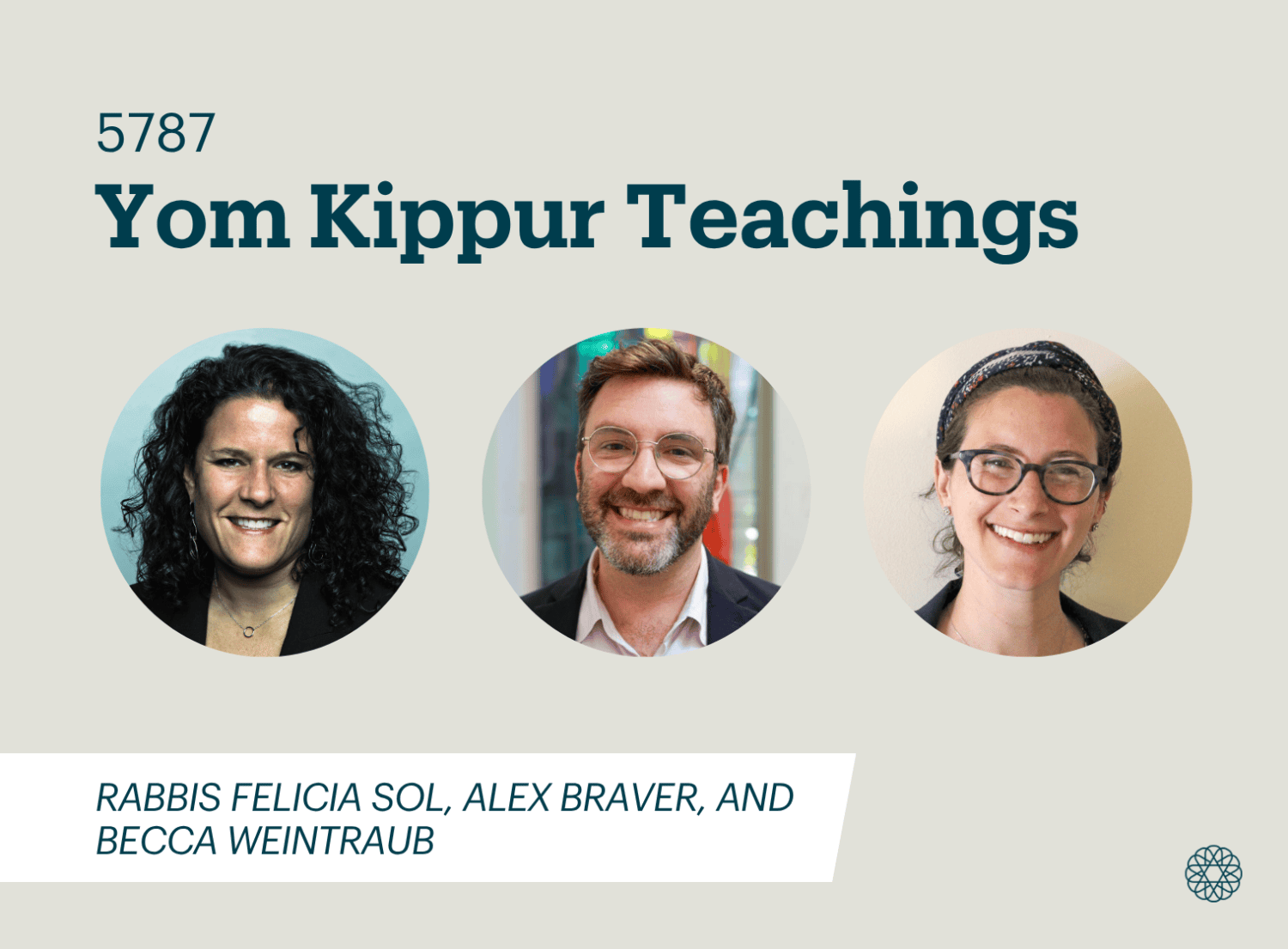
Throughout Yom Kippur 5787, BJ’s rabbis explored what it means to bring the fullness of who we are into a world that often asks us to simplify ourselves and one another. Across Kol Nidre, Yom Kippur morning, and Ne’ilah, Rabbi Felicia Sol, Rabbi Alex Braver, and Rabbi Becca Weintraub reflected on the complexity of Jewish identity; a tradition that imagines God through many names, attributes, and metaphors, resisting the idea that the Divine, or our own religious lives, can be reduced to a single way of understanding; the role of doubt, questioning, and not-knowing in making change possible; and how we might hold uncertainty without losing our capacity to choose and act.
As the day moved toward its close, their teachings turned toward the urgency of living: making room for complexity and possibility while remembering that our time is limited, and considering how we want to live the one life we have.
Watch the full sermons below or listen wherever you get your podcasts.
The full sermons and kavannot are available below or on Apple Podcasts | Spotify | Amazon Music.
Kol Nidre Sermons
Let Us Remember Who We Are | Rabbi Felicia Sol
On Kol Nidre, Rabbi Felicia Sol reflected on what happens when fear, shame, polarization, and communal litmus tests pressure us to hide or to reduce Jewish identity to a single story.
Drawing on three ancient names for the Jewish people (Ivri, Yisrael, and Yehudi) Felicia explores the fullness of our inheritance. We are boundary-crossers willing to stand against the tide. We are wrestlers who refuse easy answers and strive toward what is upright. And we are a people called to gratitude, truth, responsibility, and repair.
At a moment when so much is projected onto Jews from the outside and so much is contested within our own community, Yom Kippur asks us to stop hiding and remember who we are, alive in all our complexity, struggle, responsibility, beauty, and possibility.
Our Multiplicity Is Our Jewish Identity | Rabbi Becca Weintraub
In her Kol Nidre sermon, Rabbi Becca Weintraub begins with the exhausting calculations many Jews make about when it feels safe to reveal who we are—and asks what becomes possible when, for these 25 hours, we no longer have to hide.
Through the names Ivrim, B’nai Yisrael, and Yehudim, Becca explores the multiplicity built into Jewish identity itself. An Ivri can stand apart, cross into new territory, and carry hope for what has not yet come into being. Yisrael holds questioning alongside faith. Yehudi joins gratitude with responsibility for ourselves and one another.
Yom Kippur does not ask us to become one thing, she teaches. It asks us to become honest: to uncover ourselves, make room for all that we are, and step into the year ahead whole.
Yom Kippur Morning Sermons
The Possibility of Change Starts When Certainty Ends | Rabbi Felicia Sol
What if doubt is not the opposite of faith, but the opening through which transformation becomes possible?
In her Yom Kippur morning sermon, Rabbi Felicia Sol explores two radically different rabbinic visions of the High Priest entering the Holy of Holies. In one, a system built around precision and certainty leaves the High Priest and the elders suspicious of one another and weeping alone. In another, Rabbi Yishmael encounters an unexpected God who calls him by name and asks him for a blessing.
Felicia suggests that doubt can create the spaciousness to imagine God, ourselves, and one another differently. A question creates a “maybe.” A maybe creates possibility. And possibility makes room for change.
Teshuvah begins in that opening between what is and what could be.
The Holiness of Not-Knowing | Rabbi Alex Braver
What might become possible if we loosen our need to be certain?
In his Yom Kippur morning sermon, Rabbi Alex Braver begins with the ancient ritual of the Kohen Gadol, the High Priest, and an oath intended to ensure that every detail of the holiest service of the year would be performed exactly right.
In a moment filled with purity tests, loyalty oaths, and demands for certainty, he asks whether doubt might instead open us to encounters that surprise us, transform us, and even bring blessing.
On Yom Kippur, perhaps teshuvah begins by putting down some of what we think we know and listening for what might emerge.
There Is Never Just One Way | Rabbi Becca Weintraub
In her annual Yom Kippur letter to her children, Rabbi Becca Weintraub reflects on the creativity children bring to figuring things out and what that can teach us about Judaism.
Also retelling the story of Rabbi Yishmael entering the Holy of Holies and unexpectedly being asked to bless God, Becca explores what happens when the carefully prescribed way of doing something gives way to an encounter no one could have prepared for. Yishmael must respond in his own way, drawing on a blessing that only he can give.
Becca shares that there is no single way to practice Judaism, connect with God, or bring our gifts into the world. Her blessing for her children and for all of us is to hold onto the imagination to say “but maybe,” discover new possibilities when we feel stuck, and remember that each of us has blessings that only we can offer.
Ne’ilah Sermons
Gesher L’Hayim: A Bridge to Life | Rabbi Felicia Sol
Yom Kippur confronts us with mortality so that we might learn how to live.
In her Ne’ilah sermon, Rabbi Felicia Sol reflects on Yom Kippur as a rehearsal for death and on the urgency and clarity that can emerge when we remember that our time is limited. Drawing on Jewish teachings about revelation, multiplicity, and a “heart of many rooms,” she invites us to resist a world organized around certainty and purity tests and instead cultivate hearts spacious enough for disagreement, questions, complexity, and truths larger than any one of us can hold.
And yet, for all the possibilities before us, there is one thing we do not have infinitely: one life.
As the gates close, Felicia calls us to cross a gesher L’hayim, a bridge to truly living with dignity, justice, peace, moral grandeur, spiritual audacity, love, connection, and pride in who we are.
The Quieter, Harder Kind of Courage | Rabbi Alex Braver
As the gates of Yom Kippur begin to close, how do we turn infinite possibility into choices about how we will actually live?
In his Ne’ilah sermon, Rabbi Alex Braver explores what courage looks like in a moment of profound uncertainty. Drawing on the Torah’s command to “choose life,” a rabbinic parable about paths that wind through thickets and clear ground, and the Israelites’ fear while waiting for Moses at Sinai, he challenges the idea that courage always means choosing quickly and decisively.
Sometimes the braver act is to resist panic, make room for uncertainty, and hold one another through the discomfort of not knowing what comes next. Teshuvah asks us to believe that other choices remain possible and to cultivate the inner strength to recognize them.
As the gates close, Alex calls us toward a quieter, harder kind of courage: the courage to remain open, stay in relationship, and preserve the possibility that something new can still emerge.