
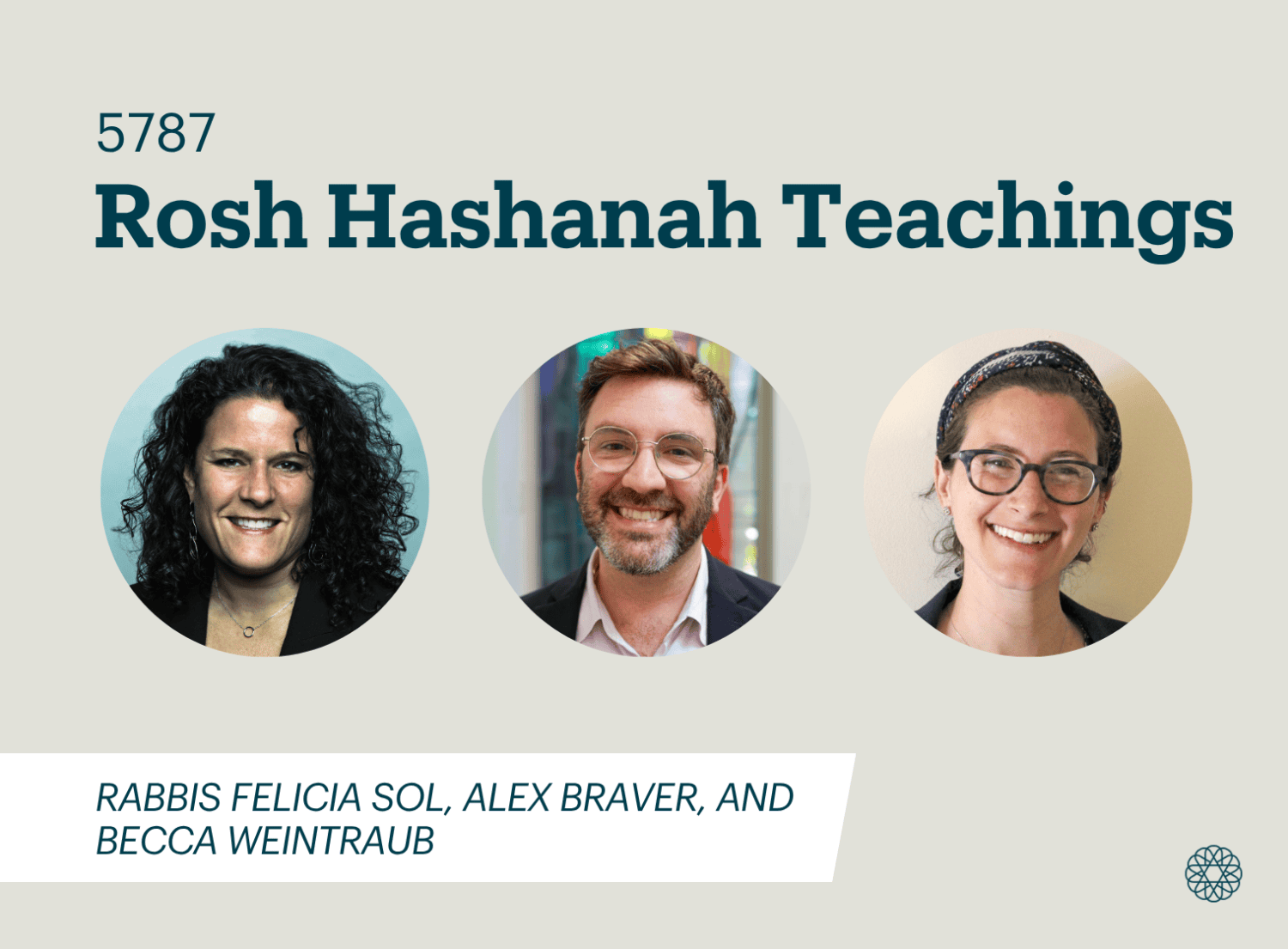
The Sacred Work of Being Human: Rosh Hashanah 5787 Sermons


Rosh Hashanah asks us to imagine that another way of being is possible in the year ahead. But how do we hold on to that possibility in a world increasingly marked by polarization, fear, despair, and uncertainty?
Throughout Rosh Hashanah services, BJ’s rabbis returned to a fundamental question: What does it mean to be human? Across sermons and kavannot, they explored our contradictions and complexity, our capacity to change, and our responsibility to resist the forces that flatten us. They invited us to join them in looking honestly at what has been while imagining what might yet be; to remain in relationship even through disagreement and disappointment; and to remember that being unfinished is not a failure, but part of the sacred work of being human.
Together, these teachings offer a vision for the new year rooted in possibility: the belief that we were not created to be one dimensional, but that we can still grow, repair, choose differently, and help create a world that is more just, peaceful, and human.
The full sermons and kavannot are available below or on Apple Podcasts | Spotify | Amazon Music.
Erev Rosh Hashanah Kavannot and Blessings
25 Years Later: Remembering September 11 | Rabbi Felicia Sol
On Erev Rosh Hashanah, 25 years after the attacks of September 11, 2001, Rabbi Felicia Sol remembers the nearly 3,000 lives lost and reflects on BJ’s experience of that devastating day and its aftermath.
From trying to reach members and loved ones to gathering for interfaith prayer and supporting first responders, Felicia recalls a city and community forever marked by those 102 minutes, inviting us to hold in memory all those whose lives were taken or irrevocably changed.
Zikhronam livrakha. May their memory be for a blessing.
At the Threshold of a New Year | Rabbi Felicia Sol
On Erev Rosh Hashanah, Rabbi Felicia Sol reflects on the threshold between the year that has ended and the one that has yet to be written. Drawing on a Talmudic teaching about giving thanks for the past and crying out for the future, she invites us to look honestly at what has been without allowing it to control us and to bring our moral and spiritual imagination to the future we still have a role in shaping.
Let the new year and its blessings begin.
Spiraling Through Time | Rabbi Becca Weintraub
On Erev Rosh Hashanah, Rabbi Becca Weintraub reflected on the Jewish experience of time not as a straight line or an endless circle, but as a spiral. Each year we return to the same holidays, prayers, rituals, and sacred moments, but we do not return as exactly the same people.
Drawing on Rabbi Joseph Soloveitchik’s teaching that we “remember deliberately, anticipate responsibly, and act precisely,” Becca invites us to bring the lessons of our past and our hopes for the future into the choices we make now. Even the round Rosh Hashanah challah can become an image of this spiritual journey: not simply circling back, but spiraling upward.
As we enter 5787, may we return to the places we have been before as people who have changed, and who are still becoming.
Alive With the Possibility of Newness | Rabbi Alex Braver
Rabbi Alex Braver offers a blessing for renewal in all its forms. Some of us enter the new year amid exciting changes; others face new challenges, losses, or absences; and some may feel stuck, longing for change that seems far away.
However we arrive at these Days of Awe, may we meet change with courage, recognize the possibility of newness within ourselves, and make 5787 a year of “good newness.”
Rosh Hashanah Sermons
The Extraordinary, Complicated Gift of Being Human | Rabbi Felicia Sol
On Rosh Hashanah, the rabbinic birthday of humanity, Rabbi Felicia Sol asks a question that feels especially urgent: Can we still have faith in the human project?
Drawing on 2,000 years of teachings about the creation of humanity, Felicia explores what it means to contain both heaven and earth, extraordinary goodness and profound contradiction. In a polarized world that continually reduces people to ideologies, identities, and worst moments, she suggests that the opposite of dehumanization may be curiosity, the willingness to believe that another person contains more than we can see.
Our tradition does not ask us to have naive faith that human beings are always good. It asks something harder: to believe that we are capable of change. What will we do with the extraordinary, complicated, sacred gift of being human?
The Antidote to Despair Is Human Possibility | Rabbi Alex Braver
In a world increasingly shaped by despair, polarization, and binary thinking, Rabbi Alex Braver asks what Rosh Hashanah, the birthday of humanity, can teach us about reclaiming the fullness of being human.
Drawing on 2,000 years of Jewish teachings about creation, Alex retells the creation story of humanity as a creature intended to be both earthly and heavenly, expansive and contradictory, uniquely created in God’s image and capable of transformation. When the world tries to narrow our choices and flatten us into categories of right and wrong, friend and enemy, our tradition calls us toward something more spacious: imagination, possibility, and the faith that another path can emerge.
Rosh Hashanah invites us to resist “narrow lives” and recover the glorious, complicated mess of what it means to be human.
Why Were Human Beings Created? | Rabbi Becca Weintraub
In her Rosh Hashanah sermon at the family service, Rabbi Becca Weintraub explores an ancient rabbinic debate over whether human beings should have been created at all, and asks what we might say in humanity’s defense.
Being human is complicated. We can be kind and impatient, generous and selfish, brave and afraid (sometimes all in the same day). But being created betzelem Elohim, in God’s image, means our complexity is not a flaw. It is what makes us human and part of what makes growth and change possible.
Rosh Hashanah gives us another year, another chance to learn, grow, discover different parts of ourselves and others, and make the world a little better.
Rosh Hashanah Second Day
American, Jewish, and Unfinished | Rabbi Felicia Sol
What does it mean to be an American Jew at a moment when our deepest commitments can seem to pull us in opposing directions?
Beginning with BJ’s founding in 1825, Rabbi Felicia Sol traces the intertwined histories of American democracy and American Judaism and the freedoms that allowed Jewish life here to become diverse, creative, and chosen from love. She then turns to the challenges of the present: rising antisemitism, threats to democracy, debates over free speech, Israel, and a polarized culture that continually demands we “pick a side.”
Felicia offers another model: covenantal belonging. Belonging does not require agreement, and disappointment does not release us from responsibility. America is unfinished. Jewish life is unfinished. Our task is not to walk away when either falls short, but to remain in relationship, demand more, repair what is broken, and continue to build.