
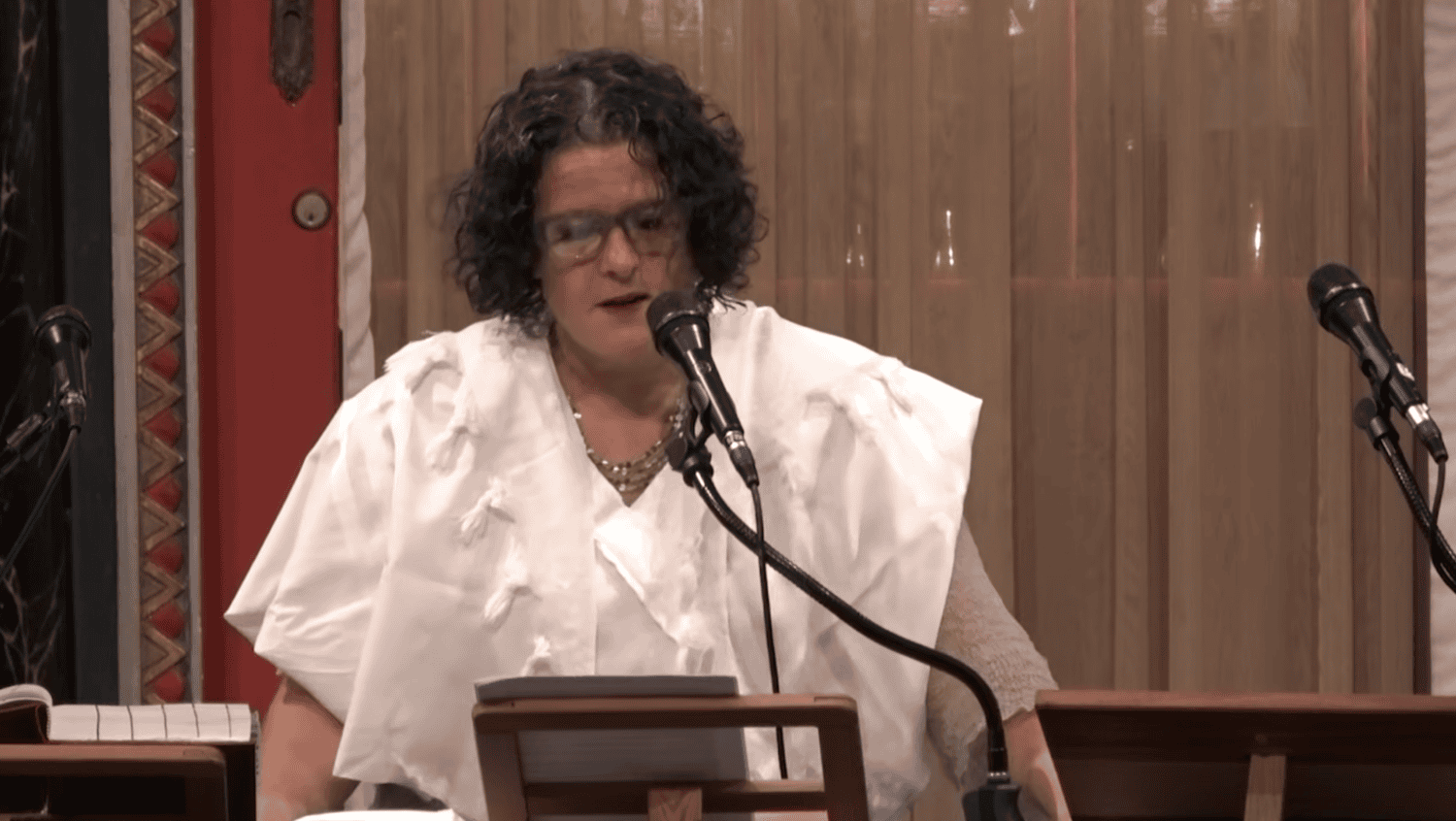
Rabbi Felicia Sol’s Kavannah for Shabbat Nahamu

Shabbat Nahamu is known as the Shabbat of Comfort. But this year, many of us arrived feeling anything but comforted.
During Kabbalat Shabbat on Friday, Rabbi Felicia Sol shared a kavannah addressing the recent stabbings on the Upper West Side, for which the alleged attacker has since been charged with a hate crime and attempted murder, as well as Mayor Zohran Mamdani’s recent video about Israeli Prime Minister Benjamin Netanyahu.
Felicia spoke plainly about the responsibility of leaders and institutions to protect Jewish New Yorkers and about her concerns regarding the mayor’s rhetoric. She reminded us that comfort does not mean danger has disappeared or suffering is over. It means finding renewed strength to face fear together, while holding fast to a moral vision in which every person is recognized as created b’tzelem Elohim, in the image of God.
We invite you to watch her remarks in full or read them as prepared below.
Remarks as prepared:
After three weeks of mourning—from the Seventeenth of Tammuz to Tisha B’Av, known as bein hametzarim, “the narrow straits”—we arrive at this Shabbat Naḥamu, the Shabbat of Comfort, longing to be comforted.
Tomorrow morning we will hear those powerful words of Isaiah:
נַחֲמ֥וּ נַחֲמ֖וּ עַמִּ֑י יֹאמַ֖ר אֱלֹהֵיכֶֽם׃
Comfort, oh comfort My people,
Says your God.
After three weeks of haftarot filled with rebuke and visions of destruction, this Shabbat is meant to offer love, hope, and a path toward restoration.
Isaiah continues:
וְקוֹיֵ֤ ה’ יַחֲלִ֣יפוּ כֹ֔חַ יַעֲל֥וּ אֵ֖בֶר כַּנְּשָׁרִ֑ים יָר֙וּצוּ֙ וְלֹ֣א יִיגָ֔עוּ יֵלְכ֖וּ וְלֹ֥א יִיעָֽפוּ׃
But they who trust in God shall renew their strength,
As eagles grow new plumes:
They shall run and not grow weary,
They shall march and not grow faint.
Notice what Isaiah does not promise.
He does not promise that danger will disappear.
He does not promise that suffering is over.
He promises renewed strength.
Perhaps that is what comfort really is—not the absence of fear, but the courage to keep walking through it.
Because tonight, many of us do not feel comforted. We feel unsettled, weary, and afraid.
In our very own neighborhood, on the afternoon of Tisha B’Av, a visibly Jewish man who had just left praying at the Jewish Center and an Asian man were both stabbed. Though the full investigation is still unfolding and we don’t know the attacker’s motives or the state of his mental health, the reported words of the attacker, together with the alarming rise in antisemitism in our city and throughout our country, give us real pause.
Many of us are asking whether our city is becoming less safe for Jews. We worry for ourselves, for our children, and for all those who are targets of antisemitic and hate crimes. We pray for the healing of Moshe Yitzhak Grunhaus and Chok Sung.
I flew home on Wednesday morning after spending three weeks in Israel studying at the Hartman Institute. I have a deep love for the land and people of Israel. I have spent years of my life studying, living and visiting family and friends there. I have led countless BJ groups on Israel trips.
Because I love Israel—and because we at BJ love Israel—I am also deeply critical of the Netanyahu government, of the occupation, and of the dehumanization of Palestinians that has become increasingly normalized in Israeli discourse, particularly in the years since the horrors of October 7th.
Over these weeks, I studied texts about faith and humanity, and I met with Israeli Jews and Palestinians who are struggling to build a different story—to imagine what is possible and to see the humanity of the other as a religious obligation.
And for all my criticism of Netanyahu and the policies of the Israeli government—and I know Alex and Becca feel similarly—the rhetoric of Mayor Mamdani has too often been inflammatory, disproportionate, and singularly focused on Israel.
Criticism of Israel is not antisemitic by definition. But when the mayor of the city with the largest Jewish population in America consistently singles out the Jewish state with such derision, it is difficult not to worry about the consequences. At a moment of rising antisemitism, such rhetoric risks deepening hostility toward Jews, even if that is not its intent.
In this week’s parashah, Moshe tells the people how he pleaded with God for one final chance to enter the Promised Land.
וָאֶתְחַנַּ֖ן אֶל־ה’ בָּעֵ֥ת הַהִ֖וא לֵאמֹֽר׃
I pleaded with God at that time, saying:
“Let me, I pray, cross over and behold the good land beyond the Jordan—the hill country and the Lebanon.”
Moshe’s longing is profound. After forty years of leading the people through the wilderness, he asks only to enter the land he has devoted his life to reaching. God has already decreed that he will not enter, and yet Moshe prays one last time.
Va’ethanan.
He pleads.
Rashi understands Moshe’s prayer as pure supplication. He knows he has exhausted every claim of merit. He asks only for grace.
Rabbi Samson Raphael Hirsch notices something different. Earlier in Devarim, Moshe places responsibility on the people for his inability to enter the land. Here, however, he turns inward. His prayer becomes an act of humility. He stands before God without accusation or blame but in contrition.
The Tur HaArokh imagines yet another transformation. Once Moshe accepts God’s decree, his prayer changes. If he cannot lead the people into the Promised Land, then he prays that Joshua will have the strength to do so. His concern shifts from his own destiny to the future of the people.
There is something deeply moving about Moshe’s final prayer.
He never stops longing.
He never stops hoping.
He never stops praying.
He is relentless even when he knows the answer may be no.
Perhaps that is because prayer does not always change God’s mind.
Sometimes prayer changes us.
Prayer invites us to examine ourselves honestly. It softens certainty. It teaches humility. It reminds us that even when we cannot control the future, we can still choose who we will become.
This week reminded us how much security matters.
We need leaders who take seriously the responsibility to protect every New Yorker.
We need institutions that safeguard our communities.
We need vigilance in the face of hatred.
Those things matter.
But Torah also reminds us that they are not enough.
Walls can protect us. Police can protect us.
Governments can protect us. And we need them to.
But they cannot, by themselves, create the kind of world in which we are truly safe.
Our deepest security will come when every human being is recognized as created b’tzelem Elohim, in the image of God.
It will come when Jews can walk through our city without fear.
It will come when Palestinians are seen in their full humanity.
It will come when Israelis are seen in theirs.
It will come when we refuse the temptation to reduce people to symbols, slogans, or enemies.
It will come when disagreement does not become dehumanization.
When our safety does not depend only on higher walls, but on a deeper moral vision.
That world may feel impossibly distant.
So did the Promised Land for Moshe.
And yet he never stopped praying toward it.
That, I think, is Isaiah’s comfort.
Not that the journey is over.
Not that the dangers have disappeared.
But that God renews our strength for the journey ahead.
Unlike Moshe, however, we do not pray alone.
We have one another.
We gather to strengthen one another—to give hizuk—to remind one another that hope is sustained in community.
This is what Shabbat Nahamu offers us.
Not an escape from reality.
Not permission to ignore our fears.
But the strength to face them together.
As we enter this Shabbat Nahamu, may God comfort all who live in fear, heal those who have been wounded in body and spirit, strengthen those who labor for justice and peace, and grant us renewed strength to keep walking toward the world that still lies just beyond reach.