
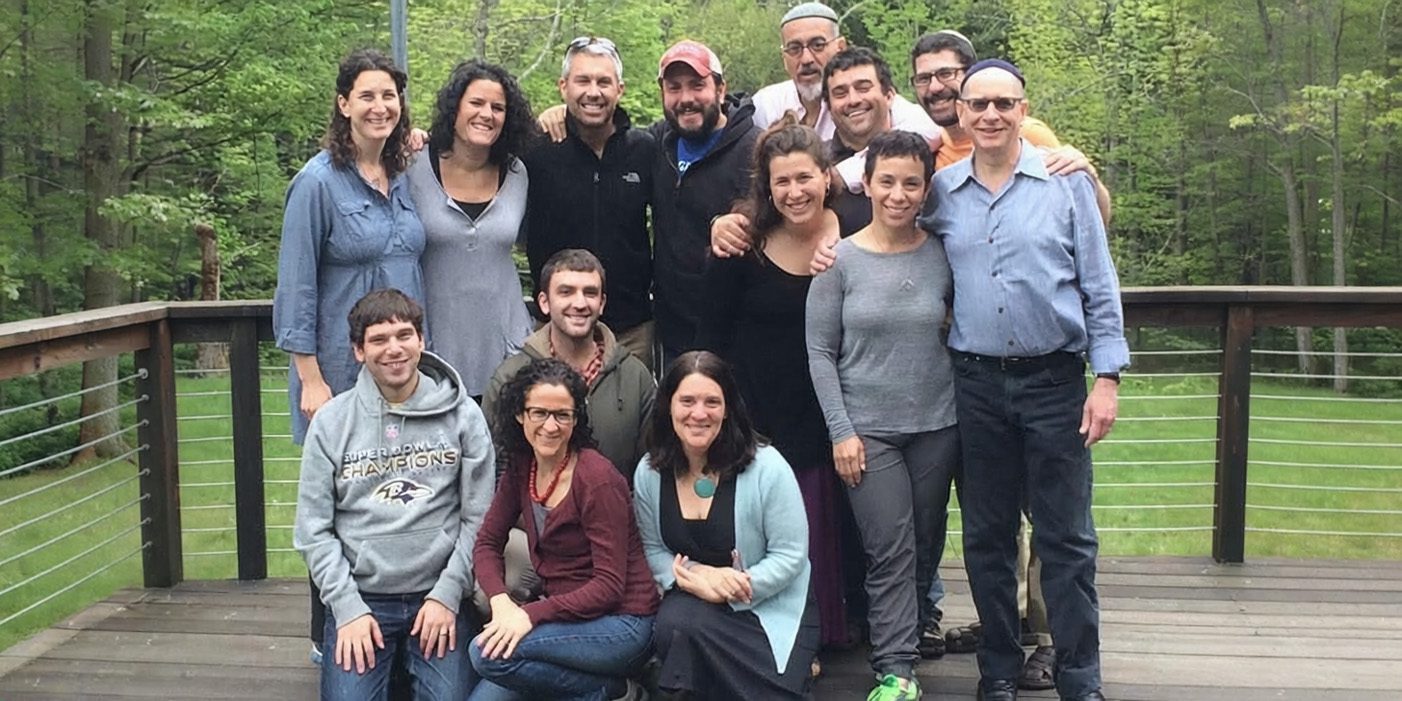
How Awesome Is This Place

Alex Braver
BJ Rabbinic Fellow, 2013–2016
New York, NY
When Jacob awakens from his dream of a ladder stretching from earth to heaven in this week’s parashah, he is shocked at this surprising revelation of God’s presence. “Mah nora ha-makom ha-zeh,” he says: “How awesome is this place!”
Like so many other BJ Rabbinic Fellows over the last 30 years, I encountered Felicia’s mentorship and leadership at a critical moment in my life. She helped shape my emerging rabbinic identity, attending to me not just as a rabbi-in-training, but as a neshamah, a soul. That sense of “awe,” of “place” and presence, has been a core part of Felicia’s vision and service, influencing not only our holy community but a generation of Jewish spiritual changemakers in the United States, Canada, Israel, and beyond.
Below, you’ll find reflections from many of the Fellows who’ve experienced the blessing that is Felicia — her ability to listen attentively and with curiosity, to lead with both love and strength, to translate a visionary plan from the dreams of heaven to the logistics of earth, to cultivate insight in staff meetings, pastoral conversations, and everything in between. I found myself nodding along as I read each piece, my own experiences of each of Felicia’s superpowers springing vividly to mind.
Beyond her ongoing work in shaping my rabbinate, I’ll always be grateful for the quiet moments we shared leading up to my 2016 wedding, when my then-fiancé Alex and I met in her office for counseling and to prepare for the ceremony. There, I met her as so many BJ members do — as someone who saw us in our fullness, and in doing so, helped us see ourselves and one another in that sacred expansiveness, too. Ten years into our marriage, Alex and I still find ourselves quoting one or another piece of wisdom we gleaned from those meetings. In the way that I know is familiar to so many of us, Felicia taught me how to say “how awesome is this place,” and to recognize myself and my relationship as a place where surprising awe and wonder can be found.
Enjoy this selection of blessings from our BJ Fellows, and click the links below to read each one in full. Then, I hope you’ll join us all in celebrating with us this Shabbat, as we continue to count our blessings and look toward a future filled with even more.
Yael Ridberg • Joshua Levine Grater • Katie Mizrahi • Lauren Holtzblatt • Dara Frimmer • Brent Spodek • Esther Lederman • Ezra Weinberg • Jonah Geffen • Sarit Horwitz • Sarah Krinsky • Tobias Divack Moss • Margo Hughes-Robinson • Aaron Leven • Alissa Platkow
Yael Ridberg
BJ Rabbinic Fellow, 1996–1998
San Diego, CA
When Jacob awakens from his dream, startled to have seen a ladder, the angels ascending and descending, and feeling the presence of God in what he thought was an ordinary place, he says: Mah nora hamakom hazeh — “How awesome is this place,” and then, v’anokhi lo yadati — “and I, I did not know.”
The verses reflect clarity and curiosity — two palpable elements of your leadership at BJ. You have taught by example that awe and wonder are rarely found in the thunderclap of experience, but more so in the cultivation of relationships. You know that kedusha (holiness) can be found in this place, this room, this shiva house, this Shabbat table, this hard conversation, under this huppah, with these children, at this board table — and that since we, so often, do not know it, your example is a blessing. Joy, struggle, and reverence can often be found in the same moments, and all are ways of expressing the awesomeness of presence.
Jacob did not only notice the dreamscape. He took the stone that had been under his head while dreaming, and set it up as a monument, and he named the place beit el — the house of God. Your makom and your bayit, your place and your home have been, and will continue to be BJ — the ordinary and extraordinary place that holds you, and the place you have helped to make holy.
Mazel tov!
Joshua Levine Grater
BJ Rabbinic Fellow, 1998–2000
Chief Executive Officer. Friends In Deed
Pasadena, CA
Dear Felicia,
In Jacob’s dream, the Torah describes a ladder, mutzav artzah v’rosho magia hashamaymah — firmly planted on the earth, yet reaching toward the heavens. What a beautiful image for the rabbinate, and particularly for the kind of rabbi and leader you have been for nearly thirty years.
Your feet have always been firmly planted in the life of BJ, accompanying your community through joys and sorrows, celebrations and struggles. At the same time, you have inspired people to reach higher, to deepen their engagement with Torah, strengthen their connections to one another, and imagine a more compassionate and just world.
You and I have been part of this rabbinic community almost from the beginning of the fellowship. We have witnessed tremendous changes, navigated challenges, celebrated successes, and experienced our share of tears and laughter. There have been retreats with weird dogs, singing in restaurants, hard conversations, silly games, and countless opportunities to learn from one another. Through it all, I have seen your commitment, resilience, deep love, and dedication to your congregation.
How wonderful that BJ, the community you have helped nurture for nearly three decades, now turns to you as its Rosh Kehillah. What a beautiful affirmation of your leadership, and what an exciting opportunity to help shape its future.
Here’s to the next thirty years of reaching toward heaven while keeping your feet firmly planted on the ground. And perhaps a few more weird dogs along the way!
Hatzlaha rabbah and mazal tov!
Katie Mizrahi
BJ Rabbinic Fellow, 2004–2006
Rabbi, Or Shalom Jewish Community
San Francisco, CA
During my time as a fellow, Felicia was the one on the senior rabbinic team who took grand visions and made them real. She was the organizer and the detail person, keeping things on track and always working hard, whether or not the task was glorious. I saw this in her work with young adults, with the women’s retreat and with much of the human infrastructure at BJ that helped members connect to one another and to meaningful learning, support and growth. Pastorally, Felicia is solid and fearless. She is ready and able to accompany others through dark valleys, staying present through situations that might lead others to resort to platitudes and avoidance. She is the kind of leader who shows her strength through vulnerability, modeling for others how to open the heart and care deeply, even if it sometimes means shedding a tear. She can be serious, but also seriously joyful, and some of my favorite moments with her have been moments of uncontrolled laughter. She is a person who knows how to live fully, whether showing up in joy or in sorrow. Felicia has long been a blessing to BJ and I trust that this new chapter will bring new levels of blessing to her and to the community. Mazal Tov!
Lauren Holtzblatt
BJ Rabbinic Fellow, 2005–2007
Co-Senior Rabbi, Adas Israel Congregation
Washington D.C.
There are a number of ways Felicia has influenced my rabbinate. Amongst the most important were watching the meticulous care she gave to congregants and the fellows (past and present). Watching her remember details of people’s lives, follow up to support and give tremendous love helped literally shape that most important part of the rabbinate for me.
I remember the first time I met Felicia, before I was a fellow, when I was working at the BJ religious school. What struck me immediately was that she was so real. There was not a different person standing in front of me than the rabbi I experienced on the bimah. No “rabbi” voice or moat between the congregation and her. Boundaries were always appropriate, but there were no unneeded walls. That profoundly shaped my rabbinate, my presence on and off the bimah and how to be a rabbi in your own skin.
Felicia has modeled a dor hadash of leadership, pushing boundaries and reminding the Jewish world that none of us have to be one thing. She is the first female senior rabbi at BJ, she was the first fellow to join Roly and Marcelo on the leadership team, she modeled how to be a pioneer in being a single parent and lead a large synagogue. She also has been a leading presence of ahavat Tzion while also including criticism of the political decisions of the government there.
I am in awe of her leadership.
Dara Frimmer
BJ Rabbinic Fellow, 2005–2007
Senior Rabbi, Temple Isaiah
Los Angeles, CA
One of the most awe-inspiring moments Felicia helped bring into my life was a moment of seeing myself more clearly.
As a rabbinic fellow at BJ, with Felicia as my mentor and boss, I was weighing the final two congregations on the West Coast where I might serve after the fellowship. I was certain my future lay in the Pacific Northwest, not Los Angeles. Felicia listened as I processed my visits, my impressions, and the work each congregation was imagining for me…especially the possibility of helping shape the next chapter of Jewish life at Temple Isaiah in Los Angeles. Then, with her characteristic gentleness, deep love, humor, and extraordinary wisdom, she helped me see something I could not yet see for myself: that my happiness, wholeness, and sense of purpose might actually be found in LA. (She even assured me that I could keep my Pacific Northwest fantasies alive in Los Angeles: Nalgene bottle and Patagonia fleece included.)
Twenty years later, I am still here, Patagonia fleece and puffer vest at the ready. And she was 100% right.
Felicia has a remarkable gift for helping people discover what is already stirring within them. She doesn’t tell you who to be; she listens deeply enough, asks the right questions, and creates the conditions for you to recognize it yourself. That is a gift I have carried with me ever since.
The makom, the sacred space, that Felicia’s Torah has helped shape for me is the rabbinate I try to inhabit every day. My leadership is modeled in so many ways on hers: her wisdom and humor, her authenticity and courage, her willingness to stay in difficult conversations, navigate tension without flinching, speak truth with compassion, and always to make room for joy.
She taught me that leadership is not about having all the answers or smoothing over every disagreement. It is about creating a community spacious enough for honesty, complexity, belonging, and transformation. It is about helping people see possibilities they could not see alone.
Mazal tov to you, Felicia, to your family and friends, and to the entire community of B’nai Jeshurun. In the words of our ancestors: Let us adore the ever-living God, and render praise…for creating YOU!!
Brent Spodek
BJ Rabbinic Fellow, 2006–2008
Relationship Coach and Rabbi Emeritus, Beacon Hebrew Alliance
Beacon, NY
In Parashat Vayetze, Jacob awakens from his dream and declares, “Achen yesh Adonai bamakom hazeh, v’anochi lo yadati” — Surely God is in this place, and I didn’t know it.
The remarkable thing about Jacob’s revelation is that nothing about the physical place has changed. The rocks are still rocks. The wilderness is still wilderness. What has changed is Jacob’s capacity to recognize the holiness that was there all along.
In Bereshit Rabbah (68:9), Rabbi Huna, citing Rabbi Ami, asks why God is sometimes called HaMakom — literally, “the Place.” The answer is striking: God is the place of the world, but the world is not God’s place.
God, in other words, is not contained within the world. God is what makes room for the world to exist.
I’ve come to think that one of the most important things a rabbi can do is precisely that: make room.
A few years ago, I was going through a particularly painful period, feeling increasingly isolated and estranged from people and institutions that had long been important to me. I was corresponding with Felicia about something entirely different, but mentioned what was happening.
Her response was simple: “We are only an hour plus away…if you want to be less lonely as a Jew.”
There was no grand theological pronouncement, no attempt to solve the problem, no suggestion that I ought to feel differently. Just a reminder that there was room for me.
That response captures something essential about Felicia’s rabbinate, something I’ve witnessed repeatedly over the years. She brings a remarkably grounded, non-reactive presence to situations that could easily invite anxiety, judgment, or defensiveness. She listens deeply, responds deliberately, and leads with love rather than bluster.
And in doing so, she creates space in which other people can discover something sacred.
Perhaps that is what it means to be Rosh Kehillah: not simply to lead a community, but to help create a place where people can encounter one another, themselves, and the Divine with greater openness and honesty.
Felicia, thank you for helping so many of us discover that holiness was here all along, even when we didn’t know it.
Mazal tov, with love and gratitude.
Esther Lederman
BJ Rabbinic Fellow, 2008–2009
Director of Congregational Innovation, Union for Reform Judaism\
New York, NY
Here is what I think about when I think about Rabbi Felicia Sol:
Piercing kavanot at Kabbalat Shabbat.
Passionate table thumping during a niggun.
Sermons that challenge and ask us to do better.
Drashot rich in ancient Jewish language.
A wicked laugh and sense of humor.
Holding a circle of mourning women for their dying friend.
Mentorship that comes with just the right amount of chesed and din.
A deeply courageous human being.
A moral leader who is not afraid to say the hard things.
A blessed rabbi among the people of Israel.
Ezra Weinberg
BJ Rabbinic Fellow, 2008–2009
Founder of Areivut and Jews Get Divorce
New York, NY
One of Rabbi Felicia’s great gifts is her seemingly innate ability to “show up’ in a way that conveys patience, trust, and an unmistakable sense of “I’ve got your back.”
I experienced this during a particularly transitional period in my life, when I was navigating significant personal and professional changes and trying to find my footing in a new chapter. Rabbi Felicia had a remarkable way of checking in periodically — not too often, not too rarely — that left me feeling genuinely cared for, supported, and accepted. She has an incredible degree of emotional intelligence and an intuitive sense of what people need.
And when it came time for me to step into a new version of myself, no one in the BJ community stepped up quite like she did. She not only took the time to understand my evolving life and path, but also helped others understand and embrace it. That went far beyond anything I could have expected, and it meant a great deal to me.
Jonah Geffen
BJ Rabbinic Fellow, 2011–2013
Rabbi, First Hebrew Congregation
Peekskill, NY
Jacob lies down wherever the night finds him, with a stone under his head. There are no walls, no ark and no minyan, just a place. He dreams of a ladder with angels going up and angels coming down, and in the morning he says:
וַיִּיקַץ יַעֲקֹב מִשְּׁנָתוֹ וַיֹּאמֶר אָכֵן יֵשׁ יְהוָה בַּמָּקוֹם הַזֶּה וְאָנֹכִי לֹא יָדָעְתִּי
“Jacob woke from his sleep and said, ‘Surely God is in this place, and I did not know it.’”
Only then does he say מַה־נּוֹרָא הַמָּקוֹם הַזֶּה, how awesome is this place. The place hadn’t moved, and the stone was still a stone. Jacob was the one who woke up.
From 2011 to 2013 I spent twenty hours a week at BJ, a student doing everything a rabbi does, a congregant trying to be what he witnessed growing up.
I thought I knew where the holiness lived. It lived in the text and in the teaching, and everything else was the road you walked to get there.
Then one day, in her office, Felicia explained to me how she works. I remember the veil lifting from my eyes. This was work, real professional work. It wasn’t whole if it was learning and teaching. It was also the hundred quiet things that hold them up, done with care and done well.
I had been watching the angels going up, and she showed me the ones coming down. The phone call was a place. The calendar was a place. Even the meeting nobody wanted was a place. God was in all of them, and I hadn’t known it.
Felicia taught me that this work is holy. She also taught me that it’s mine.
Sarit Horwitz
BJ Rabbinic Fellow, 2013–2017
Director of Rabbinic Leadership Programs at the Shalom Hartman Institute
New York, NY
Felicia has been hugely influential in the way that awe itself — and the process of seeking awe — has become a foundational component of my rabbinate. Early on, Felicia encouraged me to approach the world with curiosity. I can still hear her in my head, “Let’s get curious about that.” What started off as something that felt repetitive turned into cultivating a disposition that could only become engrained in me through a discipline that deliberately wants to find awe in the world. And Felicia was able to help cultivate that in me because it’s how she lives and breathes. She gives so fully to others because she lives her life with an openness to receive the awe that is in the world if we allow ourselves to see it. But it doesn’t reveal itself to us if we aren’t curious. She pushed me to approach texts, people, dilemmas — everything, really — with a posture of curiosity. In this way, Felicia was giving me the most important tool to see the world with the possibility of awe. Her Torah taught me the value of approaching something with a question — wondering what something can be. This orientation transformed who I became as a rabbi and shaped the way that I am able to find awe in the people I encounter and the Torah I learn and teach.
Sarah Krinsky
BJ Rabbinic Fellow, 2016–2018
Associate Rabbi, Adas Israel Congregation
Washington, D.C.
Rabbi Felicia Sol is a force. At once grounded in the eretz and stretching toward shamayim, she has been a model for me as to what it can look like to grow into, lean into, and assert one’s power. And crucially — radically, even — Felicia’s power is not about, was never about, contorting herself into a model that was molded for someone else. It is about becoming, and teaching, a version of power that is uniquely, undeniably her own.
Felicia is a powerhouse on the bimah. When she sings, she does so with her whole soul, opening up her depths to those whose prayer she is leading. And when she speaks, she does so with her whole heart. Felicia shows that vulnerability and strength are not opposites, but rather absolutely requisite complements to one another. For a young woman trying to find her way in a rabbinate, that was not only powerful, but outright transformative, for me to witness.
Felicia is a powerhouse in the workplace. She leads a staff and institution with the same attention and intention that she brings to every corner of her rabbinate — witnessing, challenging, loving and believing in those who come into her orbit with full presence. To work with and for Felicia is to be fully seen. It is a gift.
And Felicia is a powerhouse in her family. When culling through my memories of my time at BJ, and with Felicia in particular, so many of the most beautiful and lasting moments were in her home, around her kitchen table (or maybe chasing her kids up West End Ave as they scurried away on their scooters). As I have myself become a parent (including to an Aiden!), I have often found myself asking “WWFD” (what would Felicia do) — how would she respond to this moment with curiosity and compassion — and trying to then act accordingly.
The pasuk that we were invited to respond to, from this week’s parsha, is
“Mah nora ha-makom ha-zeh” — “How awesome is this place.”
The word nora, translated here as “awesome,” comes from the provocative intersection of awe and fear. The sensation of respect that is so complete, so overwhelming, that one is simultaneously drawn to come inexorably closer, while also wanting to stay safely at a distance. This is what it was like to step into BJ, and into Felicia’s sphere, as a student. To watch her was a lesson, always. To learn from her was a privilege. To grow to know and love her has been an ongoing gift.
Mazel tov, Rabbi
Tobias Divack Moss
BJ Rabbinic Fellow, 2017–2019
Rabbi, Or Chadasch
Vienna, Austria
There’s Divinity in A Staff Meeting
When I showed up to my first half-day, all-staff meeting during my fellowship year, I have to admit I wasn’t expecting to find myself thinking: “Mah nora ha-makom ha-zeh, eyn zeh ki im beit Elohim” — “How awesome is this place; this is none other than the house of God.” But then again, I’d never been to a Felicia-led staff meeting before.
I was in awe of how she connected with each person as they entered the room, and how thoughtfully the day’s program brought together people from across BJ’s staff departments, united us around our shared mission, and expressed genuine concern for everyone in the organization. It was clear that none of this happened by accident. It reflected Felicia’s care for the people in the room, beyond their roles, and the intention and skill with which she and the rest of the leadership team had prepared.
Within that spiritual and practical container, I was able to connect more deeply with my many behind-the-scenes colleagues, understand how wide-ranging the synagogue’s activities are — and feel the Godliness of a Felicia-led staff meeting. Awesome!
Margo Hughes-Robinson
BJ Rabbinic Fellow, 2018–2020
Executive Director, New York Jewish Agenda (NYJA)
New York, NY
When I reflect on Felicia’s leadership, I can’t help but think of the sense of place she creates with her rabbinic presence. It’s from Felicia that I learned how to bring both chesed and gevurah to a moment of pastoral encounter, providing both boundaries and a well of acceptance and care. I have been grateful countless times to learn from her how best to deftly navigate moments of professional or personal questioning, how to return to a place of calm confidence, how to discern the best next step with clarity and a deep sense of compassion.
Her wisdom as a teacher exists most prominently in her ability to create a sense of makom within a conversation, bringing one into a space of grounded honesty, a place where posturing falls away and where truth resides without a need to push or insist upon itself. Felicia is a mashpia in the truest sense: not a teacher whose impact is influence in one direction or another, but who reflects back and creates the space to sit in what is real.
Aaron Leven
BJ Rabbinic Fellow, 2021–2023
Associate Rabbi, Nefesh
Los Angeles, CA
Over the past few years I’ve felt more and more committed to the middah of seder, order. Rabbi Yisrael Salanter taught, “First a person should put his house together, then his town, then the world.” It was in Felicia that I first saw this modeled, and taught so beautifully. There are moments with Felicia that are constantly with me, especially as I navigate new and sometimes scary moments in my rabbinate, and in my life.
The first was a moment, early on in my fellowship, when I was having a particularly hard time. For months I had been venting about things that were weighing on me, that in hindsight were manageable. But I wasn’t ok, and it was affecting my personal life, and I imagine my work. Felicia didn’t shame me, didn’t judge me, but really saw me. She was direct and clear and supportive — she named that something seemed off, but beyond that, she unequivocally and unconditionally offered her support — however I needed it. It was this moment I still recall as the moment that I came to understand I wasn’t ok, I needed help, and that I had someone who I admired and valued so much fully in my corner. It was at this moment I was able to begin to cultivate the seder in my own life that would allow me to again bring my full self to my emerging rabbinate, to my family, to my community. I will always be eternally grateful.
The second was a moment in which Felicia had given a particularly vulnerable, and very brave sermon. I was moved to tears. Which is what made what took place next all the more shocking. Someone in the kahal marched up to her after services and began to address her in ways that were beyond unacceptable. I will always remember the calmness, poise, and clarity with which Felicia responded. It was so clear to me that I was watching someone who was a master of her craft — who had a clear sense of internal seder, of moral clarity, someone that would not back down, would not be disrespected, but also would stay connected to herself, and her highest values, even for someone who was not giving her kavod. The seder she had clearly cultivated in herself was so moving, and so inspiring.
One of the greatest blessings of my life is to call Felicia my mentor. I can only hope to bless her with more seder that she may be there for, her family, her community, and B”H those of us around the world lucky enough to call her our Teacher. And I hope that when she needs any help finding some of that balance, that I am among the many that will be there to offer my unconditional love and support.
Alissa Platkow
BJ Rabbinic Fellow, 2022–2024
Assistant Rabbi, Westchester Reform Temple
Scarsdale, NY
Felicia is a constant facilitator of awe. She is a masterful wordsmith, able to string together language that articulates not only what is in the hearts of BJ congregants, but of Jews and people throughout the world. It is not uncommon for her to be chosen as the speaker in moments of communal challenge, because her words elevate and ground us in the Torah of that particular moment. With each word woven together, her Torah allows us to feel closer to one another.
But there is also a level of vulnerability (and sometimes tears) that she brings to her Torah that allows us as a community and as fellows to be close to her. She not only shares her Torah selflessly, but she shares her actual self. It is in this way that she brings the words of Jacob alive, “Akhen yesh Adonai bamakom hazeh v’anokhi lo yadati — surely God is in this place, and I did not know it.” She creates a makom that illuminates the presence of God in our day to day and in our vulnerabilities. Through this modeling, Felicia teaches all of us that this is not only ok, but a way to make Torah real in our lives and the lives of our communities. Plus, she has been doing this remarkably at BJ for three decades. Perhaps it is the sheer stamina of her tenure that fills us with awe: that in all this time of giving herself so wholeheartedly to us, she has never grown tired, disillusioned or bored.
Felicia, as you move into this new role, may you continue to share your tears of love and awe with us, giving us permission to bring our full selves onto the bimah. May you keep creating the makom in the sanctuary and far beyond it, where we can recognize God in the ordinary and the tender. In moments of strife, may you continue to find the words that both lift us up and hold us steady, and may you know that we hope to hold you steady too. May this new role bring you the same freshness and wonder you have brought to your work for three decades, and may you always be surrounded by the awe you have helped us discover.