A Lost World

Thank you Roly, Marcelo, Felicia and Myriam for the privilege of speaking to our community today.
I was born in Brooklyn in the late ‘50s, the third of three daughters of Sarah and Jack Borger. I grew up knowing that there was some horrible “thing” that happened in our family, and, although there was very little discussion about it, the feelings, the trauma, hung in the air as an unspeakable but very palpable experience that affected each of us profoundly.
My mother, born in New York City in 1912, was the daughter of Anna and Samuel Cohen, Russian immigrants who came to New York to escape persecution at the beginning of the 20th century. My father, born in 1913 in Dombrowa, a city outside of Krakow, Poland, was the son of Ernestine (Esther) and Herman (Herschel) Borger. My father came to New York in 1948 at the age of 35 having spent six years in Siberian labor camps and then 3 years as a displaced person in Paris. His parents were killed sometime in the ‘40s in Poland.
My parents met on a blind date in December 1948 and married six weeks later. My mother was the first college graduate in her family, had many interests, both cultural and political, and, I believe, was a good intellectual match for my scholarly father. However,
their relationship was what I considered a “mixed marriage”—she was an American Jew, born to uneducated, Jewishly observant Russian immigrants, and he was a Polish Holocaust survivor, exiled from a place that had been home to generations of his well-educated and urbane Jewish family. My father spoke English perfectly, and both my parents spoke Yiddish, but there was always a chasm between them that a common language just couldn’t bridge. They came from two different worlds, and, most poignantly, my father’s pain and loss just couldn’t be touched.
I believe that my father’s life as a refugee was both a blessing and a curse. A blessing, of course, since he survived, had a strong marriage, three healthy children, made a living in a field that he was passionate about, and, being the urbanite that he was, became the consummate New Yorker. But the curse would always linger: he was, in fact, in exile. He was driven from a place that was his intellectual and familial home. He was a Polish Jew and, before the Holocaust, his life there was dynamic, meaningful and filled with promise.
What I will tell you about my father’s life in Poland are anecdotes heard throughout my childhood, mostly from my mother, with some information from his cousin, Morris Borger. Morris was from Mielec, a small city about an hour outside Krakow where my father, uncle and grandparents moved to when my father was a teenager. Morris stayed in Mielec until 1941 when the city was overtaken by the Nazis. Through pure luck he escaped this Nazi invasion and went on the run for the next 4 years. Where did he run to? How did he survive? I don’t know; he never told me. He and my father reunited after liberation and were together in Paris until immigrating together to NY. How did Morris, who wasn’t in Siberia with my father, reunite with him after liberation? I don’t know. So many unanswered questions lost to history.
Morris and my father were together in Siberia and then Paris, and then came to the United States together in 1948, sponsored by their cousins, the Zuckers, who had escaped from France in 1940. Morris and my father lived with the Zuckers on West End Avenue and 88th Street (yes, right around the corner). Eventually they each married American women and Morris lived here on the UWS with his family until making aliyah in 1990. After my mother’s death in 1989, Morris was the sole source for any information I had about my father and his family in pre-World War II Poland.
I need to emphasize this: my father never talked to my sisters and me about his experiences during the war; he rarely spoke of his life before the war; and hardly ever spoke about his parents, my grandparents. As I grew into adulthood, found my own Jewish community and benefited from the media’s great interest in the Holocaust, I began to understand that my father had not only lost his parents but he had also lost his culture, his profession and his way of life.
One more thing I need to emphasize: these are my own perceptions, culled from years of living with a visceral understanding of my father’s life, not from actual testimonies or hard facts. What I tell you may not be the whole truth; you may wonder how life in Poland, for Jews, pre-World War II could have been a good, or fulfilling, existence, or exempt from great fear and foreboding. All I have to go on are the faces in the pictures, the stories Morris tells me, and the very strong sense that my father, though he loved his American family and cherished many American ideals, was, in fact, a stranger in a strange land, yearning for what was.
My father, known by his Polish name Mundek, grew up in a relatively well-off family. His father Herschel was a businessman; his mother Esther Koller was a housewife. They moved to a bigger city, Rzeczow, when my father was a child. There he attended a Gymnasium where they studied Latin along with intensive study of Greek and Roman classics, literature and art. His cousin Morris told me that they went to state-operated schools where they were immersed in Polish literature, national myths and war heroes; they were, in fact, Polish patriots. There was always a question, however, whether Jews could really ever become Polish without a hyphen, that is, a Polish-Jew. But my father lived and studied among non-Jews and, it seemed, considered himself Polish. He believed that his future would transpire on Polish soil.
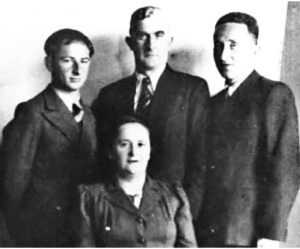
My father’s exceptional education continued—by 1937 at the age of 24 he had graduated from the University of Krakow with a law degree. From there he worked for a human rights lawyer (quite a concept in pre-war Poland) up until the summer of 1939 when he and much of his family — his brother Benek, age 21, his cousin Morris, age 19, his aunt Hela Koller, her husband Leib Koller, her brother Sam Koller, and Hela and Leib’s 3 year old son, Lulek — fled east in anticipation of the German invasion.
Here is an anecdote my mother told me: by 1939 my grandparents had moved from Rzeczow to Mielec, another small city close to Krakow. They had a beautiful home that they didn’t want to abandon for the unknown. The common family lore is that my grandmother said to her sons, “you two should leave; but don’t worry, nothing will happen to us here. We’re safe in our home.” From what I understand, my grandparents were safe in Mielec until 1941 when the Nazis overtook the city and deported the Jews in one day. But right before September 1, 1939, my father and some of his relatives, but not my grandparents, fled east and were captured by the Russians. (Why did my father and uncle decide to leave their parents and flee? I don’t know.) They ended up in Siberian labor camps where they were enslaved for 6 years.
My grandparents were killed. I had, and still have, very few details of when they were taken from their home, where they were taken, or where and how they died. And I only learned these few details in dribs and drabs. As I mentioned, we never had conversations with my father about his parents. In fact I don’t remember any stories from him about their lives; I only learned about them from other family members.
When I was a teenager my father caught me smoking. He told me that his father, my grandfather, was addicted to nicotine and he would trade his food for cigarettes in Mauthaussen concentration camp. He ultimately died of starvation in the camp. My father knew this because his landsman, fellow countryman, Sam Garden, who survived the war and lived in New York and was in close touch with my father, was in the same camp as my grandfather and bore witness to his death. Would my father have known if not for Sam?
I sat in shock as my father told me this. No conversation ensued; he just walked away. I hadn’t even known that my father had any details about how his father died. He never made my sisters and me feel ungrateful for all our blessings, for the safe and comfortable lives he gave us. He never brought up the horrors that he and his family endured in order to make us feel, perhaps, that our teenage problems weren’t valid because they weren’t life or death. Yet this is what he chose to share with me and it still shocks me.
And my grandmother. Well, “she was on a boat that was sunk in the Baltic.” This is what our mother told us. What boat? Where was it going? Who sunk it? Why wasn’t she with my grandfather? I don’t know. My sister has researched it and hasn’t found any information to confirm it. It wasn’t until I was an adult that I felt such deep heartbreak for my father that he didn’t know where or how his mother died. And how he could even bear the pain of knowing that his well-off, well-fed father lived in hell and eventually died of starvation.
All the relatives who were with my father in Siberia survived and all immigrated to the United States in the late 1940’s except my uncle Benek, my father’s brother, who settled in Munich after the war and married another Polish survivor. They had one daughter together, my cousin Ester, who now lives in Israel and with whom I have a close relationship. Does Ester know any more than I? No. We’ve discussed this many times: her father never spoke about it either.
My father was his most animated, and, perhaps, happiest, when he got together with his Polish friends and relatives, many of whom lived in New York. They would laugh a lot and tell stories—always in Polish, never in English or Yiddish. It was their private world. And since my mother didn’t speak Polish, it was yet another thing that kept her from truly touching his world.
My family straddled two worlds—the one where I was part of a “normal” American family, and another which included both a wealth of European charm and sophistication as well as a lot of horrible, embarrassing secrets. You may not know it to look at us, because we did “normal” things: three young American girls who had lots of friends running in and out of the house, having sleepovers, listening to loud rock and roll music. But one very vivid memory sums up the “other” world: we lived in a big house in Brooklyn with different levels, and when I had friends sleep over, I always brought them to the fold-out couch in the basement, because if we slept upstairs in my bedroom, which was next to my parents’ bedroom, they might hear my father screaming in the middle of the night. And how do I explain that? The only way it was explained to me was when, the following morning, my mother would nonchalantly ask, “did you hear Daddy screaming last night?” I would nod my head and the subject would be dropped.
My father met and married my mother soon after he arrived in NY; they were both in their mid-30s and eager to start a family. If he wanted to resume his career as a lawyer he would have needed to go back to law school. I believe they thought that it just wasn’t practical at that point in his life. But he did decide to get a Masters in Greek and Roman Classics at NYU (he worked while going to school). He received a teaching offer at a college in the Midwest but for various reasons they didn’t want to leave NY.
So he left behind his two passions — law and academics. More loss. I don’t know exactly what led him to become a social worker but it was, ultimately, a career that aligned with his passion for social justice.
A great part of my father’s post-war trauma was due to the assault on his idealism. Not only did he grieve for the loss of his parents, the loss of his home, the loss of his intended future; he grieved over the human condition and the depth of humiliation and persecution that one people can inflict upon another. When he came to the United States he loved the relative freedom but hated how racism hurt so many people. I recently read that Albert Einstein, a German Jew who left Germany for the States just as Hitler came to power, became a fierce civil rights activist. He said, “Being a Jew myself, perhaps I can understand and empathize with how black people feel as victims of discrimination.” And W.E.B. Du Bois said of Einstein, “He hates race prejudice because as a Jew he knows what it is.”
These words and sentiments perfectly captured the pain that my father lived with as he witnessed, yet again, the dangerous evil of racism. My father had great compassion for all beings and taught my sisters and me that if one person is persecuted, we are all persecuted, and that there could not be freedom for anyone unless there is freedom for everyone. After leaving both law and academics I believe that he needed to choose a career that would align with his passion for social justice, hoping to make a difference. He chose to become a social worker for the New York City Department of Social Services working with welfare recipients where he saw, on a daily basis, the hardships that whole communities faced as a result of economic and social inequalities in his newly adopted country. The system continually worked against his poor clients and he eventually felt defeated. He saw that, even with the best of intentions, he couldn’t make his community or the world a better place.
My father died suddenly in 1977 at the age of 64. He wasn’t sick; he didn’t have heart disease. It was probably a stroke, though we’ll never know for sure. My sister Tina thinks he may have died because he wanted to—he had had enough. My father no doubt suffered from PTSD and undiagnosed depression but he never sought professional help. He functioned and went to work every day. But he was clearly sinking deeper and deeper into despair.
He died before it became commonplace for survivors and their children to visit their original homeland. It had never occurred to me that Poland was even an option to visit. It was a surreal state of mind, not an actual place. But by the 1990’s I had met a number of second generationers who had traveled to their parents’ homes, sometimes with their parents. Almost 24 years after my father’s death, my London cousin, David Newman, told me that he and his 22 year-old son Al were going to Poland so Al can see his grandfather’s birthplace. I had envisioned a trip like this with my sisters. However, Ricki did not want to go to Poland—it was enough, she said, for her just to imagine it. And Tina couldn’t take the time from her family. So I jumped at the chance to do this trip with my cousins. I had no idea what I was in for.
The entire trip, in April 2001, included a week in Israel and was serendipitous from the first moments. We left London by car the day after the Passover seders (we picked this time of year because it was convenient for us; the fact that we were traveling during the holiday commemorating the liberation of the Jews was a very meaningful, yet understated coincidence). We drove from England to Europe, through France, Germany, Czechoslovakia and into Poland. The road trip was fantastic! We all got along great; we laughed a lot and ate a lot. And then we crossed into Poland and I broke down. I felt like all the air had come out of me.
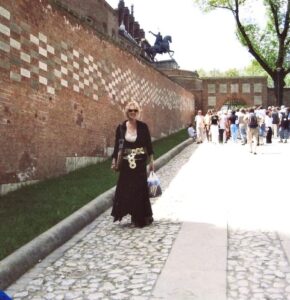
Our first day we went to the old city of Krakow which I had heard was beautiful, “the Paris of the East.” Well, I couldn’t see the beauty. I was overwhelmed with feelings of loss and doom. We walked past the university buildings and my cousin David noticed a building sign in Polish that seemed to say “Judicial” leaving us to assume that this was indeed the Law School where my father studied. (Incidentally, the buildings of the university are laid out much like NYU here in the city — many university buildings interspersed among non-university buildings in a charming part of town. I bring this up to point out that this was the first of many images that brought up intense feelings of “I can relate to this; my father’s experience was just like any college student in a big city university.”)
Next we went to Mielec. Although my father only moved there in his late teens, we always thought of this as my father’s home, perhaps because that’s where he left his parents. The hotel we stayed in was situated right near the railroad tracks. As we drove in, there I saw, big as day, the railroad station sign: Mielec. M-I-E-L-E-C. It was real. It was haunting. Is this where my grandparents were rounded up? The train track image, though used as a cliché these days to represent the plight of the European Jews, is incredibly evocative. And the city itself: I don’t know what it looked like in the 1930s when my grandparents had their “beautiful home” but now I saw lots of grey block buildings (presumably built post-war) and not much charm. But it still had an active central market square where my grandmother probably did her shopping and the train station that provided easy access to Krakow. It wasn’t a quaint village or a little shtetl. It was a small city and, again, it gave me a greater sense of what my father lost.
While walking around these Polish cities and towns I was overcome by the sense that I was walking on the ashes of a whole community. And I was. This is where so much of “it” happened. Jews, people, like me, were killed. And they didn’t have graves. My grandparents didn’t have graves. My father never had the chance to mourn them appropriately. Oh my goodness, he never had the chance to mourn them appropriately! Although I always knew this intellectually, it was much more profound to actually be walking the streets where my grandparents might have perished.
I left David and Al to drive home to London while I was off to Israel to visit my friend Jan Uhrbach who was in rabbinical school in Jerusalem. A day or two later was Yom Ha’shoah (another serendipitous aspect of my trip I hadn’t planned). I’ve never experienced such a powerful and moving commemoration. As you might know, the Israelis memorialize the Holocaust every year with two moments of silence that everyone acknowledges together. Everyone. The entire country stops, a siren blaring in the distance.
That same evening I spent time with my father’s cousin Morris and, coincidently, my 18 year-old nephew Josh who was spending a semester studying in Jerusalem. Morris was the last living relative from that generation, and the last who survived the war with my father. (An aside: Morris came to NY from Jerusalem in March 2004 to escort me to my chuppah. It’s hard to put into words how meaningful that was.)
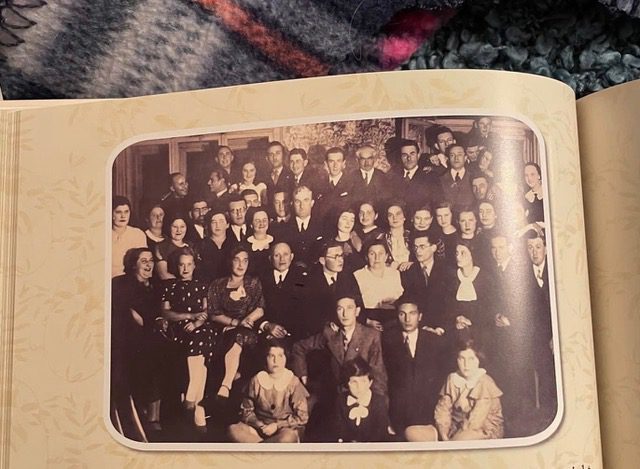
Morris brought out a large photo album from his pre-war days in Mielec. Where did he get it? Well, he told me, your father and uncle Benek and I went back to Mielec after we were liberated to see what was left. When we returned, one of my gentile neighbors told me she had gone through the items that were ransacked from my family’s home and found this photo album. She held onto it in the event that we would return someday.
My father went back to Poland? I never knew that. And he had gentile neighbors who, through their own hardships during the war, had enough compassion to save this valuable memento? My head was spinning.
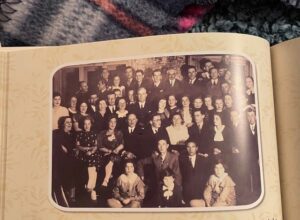
As Morris took me through it page by page, he said, “you should know the life we had then. You can’t imagine what was lost. Here’s a party with my sisters, Sala and Faige (Salpeter), and their friends. It’s 1936. They were all teenagers, or in their early twenties, and very committed to Zionism. They’re celebrating that their friend Shmuel was leaving for Palestine. A number of their friends made aliyah in the ‘30s. The ones who stayed behind all perished, including my sisters, who died in Belzec.”
I kept examining these photos, seeing many laughing faces, fashionably dressed young men and women, smoking cigarettes, drinking, eating around a large table in a restaurant or social hall. This could be my group of friends.
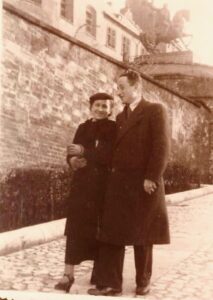
Another photo showed my father, dressed in a stylish suit and overcoat, walking in the old city of Krakow with Morris’s sister Sala, also dressed in the fashion of the day, smiling, happy. Morris said she was probably visiting my father in the city for a day or so. And maybe doing some shopping. Just like I would do. These pictures conveyed an entire culture, a way of life that was destroyed. And it looked so familiar. Another reminder that my father had a life that he probably didn’t want to leave. My heart broke for him, thinking again that his life in exile was both a blessing as well as a curse.
My trip was coming to an end. I spent the last night in Tel Aviv with my cousin Ester and her family. She and I share the paternal grandparents who perished in Poland. As soon as I arrived she asked “How was Poland? What was it like for you?” I told her that the two feelings I came away with were these: that my father lost not only his parents, but a whole life that he probably didn’t want to leave behind, and that our grandparents didn’t have a resting place. She grabbed my hand and said, “Come with me.” We walked a few blocks into a tiny cemetery. Both of her parents had recently died, within a few years of each other. She walked me to their gravesite that bore a large headstone which read across the top, in English, “BORGER.” Underneath the name, on either side of the stone, were each of her parents’ names. On the left it read: “Baruch Borger (my uncle Benek’s Hebrew name), son of Esther and Herschel Borger who perished in the Holocaust.” I turned to Ester and cried, “you gave them a resting place.”
My sisters and I try every day to honor our father’s legacy. I have two nieces and a nephew, “third generationers,” who have received very strong Jewish educations and continue to be active in the Jewish community. Though they never met their beloved grandfather, they too pay homage to his memory, each in their own way, by embracing Tikkun Olam and working to repair our broken world.
In 2003 my sister Tina went with her daughter Elana, 16 at the time, on the March of the Living, a program for teenagers around the world that takes them to Poland and Israel. After seeing Auschwitz and taking a symbolic march to the gas chambers at Birkenau, the group went to Krakow where they saw the sights and learned about Poland’s re-emerging Jewish community. On Shabbat morning my niece, whose great grandparents were killed in Poland for being Jewish, whose grandfather was exiled and persecuted for the same, conducted Shaharit services in the old city of Krakow. Where my father lived and studied. Sixty years ago. Now, two generations later, a woman, a Jew, leading services for a group of Jewish teens. My father would have been so proud.