Live now: Shaharit (Rosh Hodesh)


Back to Stories & Articles
The Week Was a Pendulum

Earlier this week I returned from Berlin, where we took 20 BJ teens on a weeklong exploration of history, memory, and Jewish life today. It was a deeply personal journey; we saw the buildings where the families of two different students had lived, and met with Roly’s daughter Yahel, who spoke to us about her own life in Berlin today. We also visited two Jewish communities in Berlin, whose leaders both credit BJ with bringing inspiration and music to their communities.
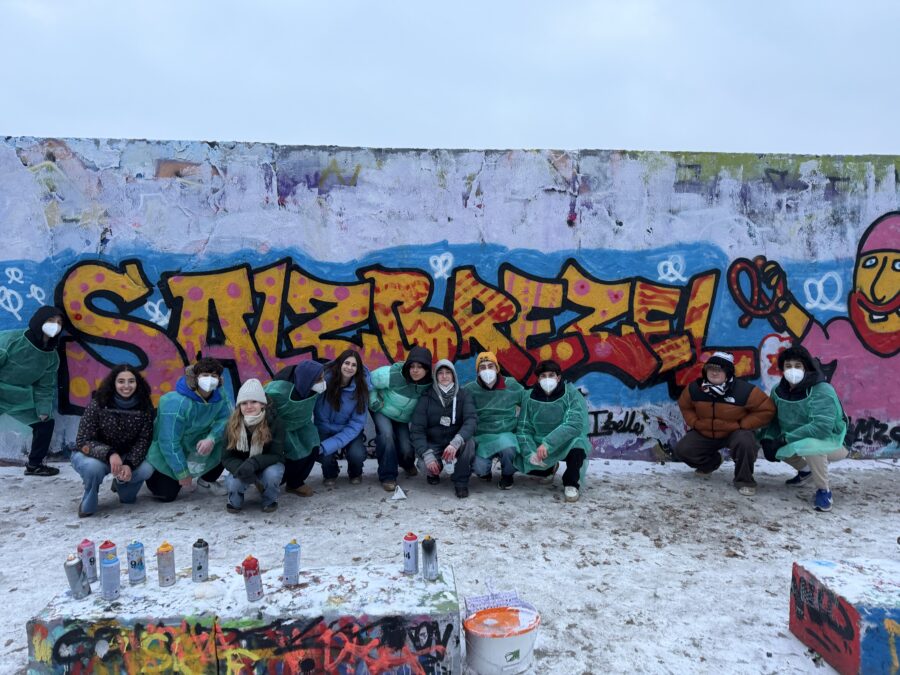
The week was a pendulum, constantly swinging between then and now. There were many somber moments as we recalled the evils of the Nazi regime and the German Democratic Republic (GDR, the Soviet regime in East Germany from 1949–1990.) There were also moments of profound joy and beauty, as we joined local Jewish communities, sang the BJ teens’ “Shavua Tov” song in Bebelplatz (the site of a massive Nazi book burning in 1933), and spray painted a wall with graffiti to honor our beloved German guide, Dennis.
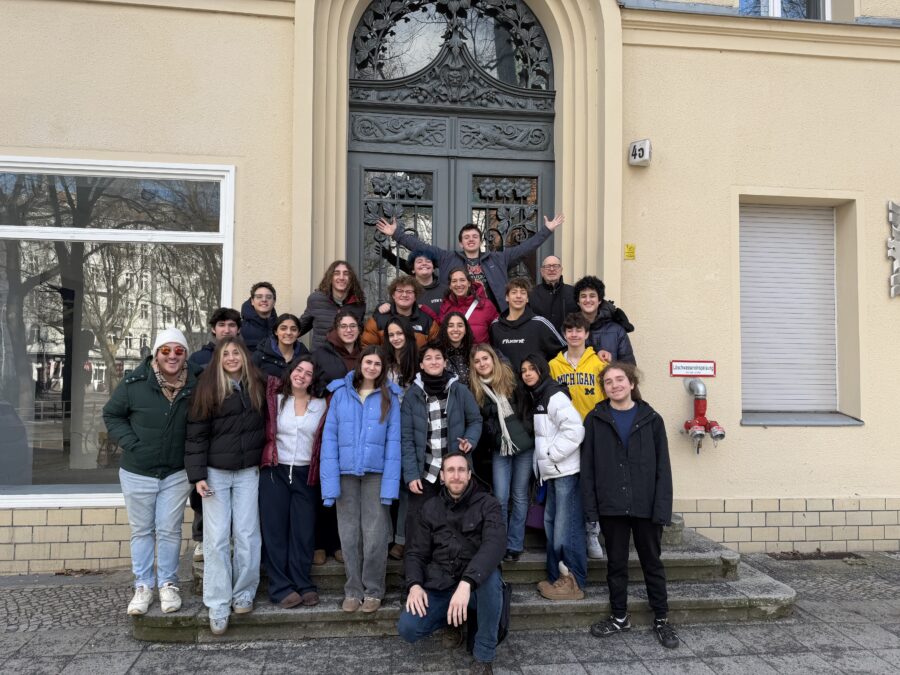
We left Germany on Rosh Hodesh Adar, the month when we celebrate Purim. The story of Purim is about transforming the threat of annihilation into a story of survival and joy. The villain of the Purim story, Haman, is understood to be the descendant of the nation of Amalek, our ultimate biblical villain. Next week, when we read Shabbat Zakhor, we will get the dual commandments for Amalek: “זָכוֹר אֵת אֲשֶׁר־עָשָׂה לְךָ עֲמָלֵק”, “Remember what Amalek did to you” and “תִּמְחֶה אֶת־זֵכֶר עֲמָלֵק מִתַּחַת הַשָּׁמָיִם לֹא תִּשְׁכָּח”, “Wipe out the memory of Amalek.”
Learning about the Holocaust, visiting historical sites and telling their stories is not just about recalling what was done to us. It is what allows us to wipe out the imprint of this kind of evil from our world. With every stumbling stone we passed, every memorial we visited and every place we said Kaddish for murdered Jews, we were transformed into people who can better recognize patterns of injustice. Understanding what happened in the past and why it happened enables us to make sure that “Never Again” is not just a slogan but a personal call to action.
On Friday, we visited Sachesenhausen, a Nazi concentration camp a few miles outside Berlin. The students initially asked, “How could the townspeople not have known what was going on?” It seems absurd that people could not have been aware of the deaths of 6 million Jews and 7 million other persecuted peoples, Soviets, and political enemies of the Nazi party. How could most of Europe have missed or ignored the deaths of 13 million people?
But as the students discussed, it is chillingly easy to turn a blind eye. “How much do we really know about what is happening in ICE detention centers right now?” One of them asked. “Do we even know where the closest detention centers are to our homes?”
It is impossible to talk about Nazi Germany without hearing its echoes in our world today, and this lesson was not lost on our students. In our closing circle, one of the students offered a poignant recap of a lesson he learned on our trip: “I always thought the Holocaust was something that could have happened to me, but being here I see that that Holocaust is something I could have been part of, or stood idly by while it happened.”
I expected to leave Berlin shaken by the collective trauma of the Holocaust, and chilled by echoes of this evil in the US today. Instead, I left full of hope and awe. We are, once again, living in a time where our neighbors are being abducted by a militarized police force and disappeared to hastily built camps and detention centers; where a leader no one expected to rise to success is grabbing power and consolidating his party’s grip, and where walls and lines of division are built under the guise of “keeping us safe from outside attack.” But in this terrifying world, our teens proved that we can truly imagine a different future. In a place of destruction and fear, they were joyfully Jewish and morally courageous. They were students of our history, learning what was done to us and to other persecuted peoples, and they are committed to wiping out the existence of this kind of evil in the world today. The salvation in the Purim story was wrought by just one brave woman—how great will our salvation be when the wisdom and passion of these teens ripples out into the world?
Shabbat shalom,
Rabbi Deena Cowans