
The Cousins I Never Had

Delivered at B’nai Jeshurun, Yom Kippur 5785.
Thank you to the Rabbis for giving me the opportunity to share this story today and especially to Myriam Abramovicz, who has done so much to honor survivors of the Shoah and to remember those who perished.
∗∗∗
As a young man, my grandfather Abel left the small shtetl of Janow in Poland where he had grown up.
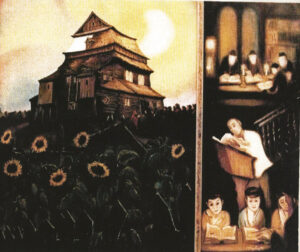
The Yizkor book, a book of remembrance, written in 1961 by descendants from the village, described it as follows:
“Before the Second World War in Janow, a small shtetl near Bialystock, lived approximately four hundred Jewish souls. It was a community of very hard-working Jewish people, who strived for the “parnosse” to support their families. In spite of that, the shtetl was imbued with Torah, spirit and the hope for freedom.”
When my grandfather left the shtetl in about 1919, his father took off his own coat and placed it on his back, telling him that it was all that he had to give him. It took him three years to cross Europe – stopping to work along the way for months at a time. He was turned back trying to enter England, but he eventually ended up in Ireland where he opened a tailor’s shop.
He left behind his parents, Hirsch Leib and Feige, a sister Leitzi, her husband Avrumle and a niece, a girl named Mottel.
Postcards and letters, spanning 21 years, in cramped Yiddish handwriting sent to my grandfather in Ireland from his family in Poland tell a story. Other pictures and documents that turned up over the years also give us glimpses of Mottel and her family.
1920: The first postcard from Abel’s sister
Dear brother,
I and Avrumle and Mottel are in good health. May God let us hear from you all good things. It is very painful for me that you were turned back, but what can one do. It is God’s decision. Please don’t be sad and don’t worry, my brother. We hope that God will help you and your family.
Yours Leitzi
When the card was sent, her daughter, Mottel, was age 3.
1925: A letter from Abel’s parents
Respectable and dear son,
We are in good health. May God give you the same and to hear good news from you. When we saw the tickets, we cried a lot. Dear Abe, we can hardly believe that you are out in the big world, and that you are soon to be married and that we will attend our son Abe’s wedding.
1925: A letter from Leitzi, Abel’s sister
Abe, I’m writing you this letter in excitement. I know that you are also the same. God knows that the times are not good here. We have never had such bad times as we are having now. Many people are emigrating now to Eretz Israel. As much as one can escape, one does. It is very difficult to leave. Chaikl, the baker, is leaving with all his family. He has already bought a piece of land in Eretz Israel. My Avreml wants very much to go there because here life gets very bitter. Oh, Abe, Mottel is crying very much because she cannot be at your wedding, but she hopes that with the help of God, she will come to you. Abe, if you could see her, you would not recognize her. What a beautiful girl she is. Be in good health and live well.
Leitzi
1925: A letter from Mottel, age 8
Dear and beloved uncle,
May you live happy and content. I am, thank God, healthy. Dear uncle, it is hard for me to believe that you will be married. I would like so much to be at your wedding. But this is something impossible. Dear uncle, I wish you the best of happiness. I remember you every minute. I don’t let you out of my thoughts. Stay in good health. Live happy. This is the wish of your niece.
Mottel
1926: A declaration
In an archive, we came across a document from the following year, a formal declaration by the second grade of the school in Janow in an elegant red and blue font addressed to “the American people.” The declaration reads as follows:
We pay tribute to the American people on the 150th anniversary of US independence.
Below the text, and in the middle of a page full of signatures of earnest students sending greetings to the United States of America, we see the proud signature; “M. Berel.” Mottel was age 9.
1929: Life in Janow
The Polish Register of Businesses publishes a listing of the businesses in towns and villages across Poland, among them Janow. Many of the businessmen have Jewish names including the butcher, baker and pharmacist. Among the tailors listed there is “A. Berel” Mottel’s father. At the time Mottel was age 12.
1936: A letter from Mottel
The letter includes a photo of herself in an elegant dress and carrying a parasol.
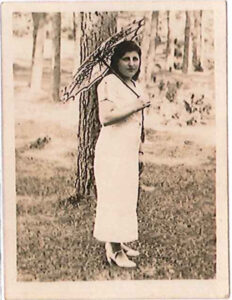
Dear Uncle,
I am sending you a picture. It is a souvenir from a dacha. Father’s mother, my bubbe, was at this dacha so I was there too for a few weeks, and I had a very good time. Please do not laugh at the way that I look in the picture. I send my very heartfelt regards to the aunt and to your children and I wish all of you to be in good health.
From me, your niece, Mottel Berel
1938: A visit to Janow
Two years later, in 1938, my grandfather made a long journey across Europe, this time by train, to visit his family in Janow. A faded photograph survives from that visit. There he is in his smart city suit (after all, he was a tailor) surrounded by his mother, sister, nephew and nieces. In the background, next to a wooden house, the camera captures the outline of a man chopping wood in the village setting. Most prominent in the photo is Mottel, now 21 years old, staring into the camera with intensity, her hands resting lightly on the shoulders of my grandfather.
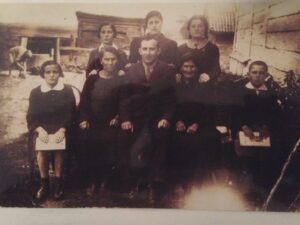
That year my grandfather pleaded with the authorities of his new homeland for permission to bring her to Ireland.
February 14, 1938: Letter from Abel to the Irish Ministry of Justice
Dear Sir
I respectfully ask for the necessary permission to bring my niece Mottel Berel, a Polish National, into Ireland, for the purposes of being adopted by me. Her father is dead, and her mother has three other girls and one boy, and is not in very good circumstances.
I have two children of my own, aged twelve and six years respectively, both going to school. I am a naturalized Irish subject and willing to sign any form of guarantee in this case. I will keep her in my own house and will give her all necessities and will not send her to work. I have two shops in the city and possess a fair amount of property.
Thanking you for a favourable reply.
Yours faithfully
The response, dated just three days after the request, was terse. The Minister of Justice “does not see his way to grant permission to you to bring your niece to this country.” With this cold, uncaring letter, the gates to Ireland, like those of so many other countries, were kept firmly shut. Mottel was 21 years old.
Postcards from Janow still kept the connection.
1940: A letter from Mottel
Beloved dear uncle and aunt and your children. When we received from you the postcard, we were overjoyed to hear about everyone’s wellbeing, our joy was great. It has been so long that we did not hear from each other. Thanks goes to comrade Stalin who saved us from the murderous hands of Hitler. When we lived near our neighbor Mordechai, you used to go into his shop. He is our good friend, has shared with us his last piece of bread, supported us all along and I ask you in the name of everyone that you should write a letter and thank him for what he has done for us. We are not in need of money but if you could send us old stuff, clothing, footwear, socks, then it will come to good use for us. Maybe it is possible to send bits of soap, maybe sugar if possible. It is going to be good. I close by writing that grandma sends regards to you, to aunty, and the children.
Mottel
She was then age 23.
1941: A postcard from Abel’s sister.
My dear and devoted brother,
Be in good health with your wife and children. Our mother and children are all well. Dear brother, we received your card today and we were very happy to hear from you. About us, what can I tell you. We are all alive. Write us about you. Greetings to your wife and children. Mottel is sending her regards.
Your sister Leitzi
Mottel was age 24.
That was the last postcard. Six months later the Nazis swept through eastern Poland. The Jews of the shtetl were rounded up. The Yizkor book describes what happened:
The enemy of the Jews, the beast with the face of a human, put an end to the dreams. Our shtetl drank the bitterness from the cup of pain, right down to the bottom….The details about the horrible destiny of our dear ones had been told to us by Avraham Lifcer and Taube Klinghofer, who jumped out of the death train and were saved by a miracle.
1944 : Testimony about the Jews of Janow
In 1944, testimony was given to the Jewish Historical Commission by Avraham Lifcer who was age 16 when he jumped from that train. A transcript of his testimony remains. He described the conditions in which the Jews of Janow were held:
Prisoners were living in basements and cellars which were so overcrowded that the prisoners could not lie down to sleep, they had to sit or stand. They received 15 grams of bread daily and one liter of soup made from unpeeled potatoes. A few persons were shot for peeling potatoes.
Six weeks later the Jews of Janow were transported to Treblinka where virtually all of them, presumably including Mottel and the rest of the family, were killed.
∗∗∗
Eighty years later, there is not much left of the former Jewish community.
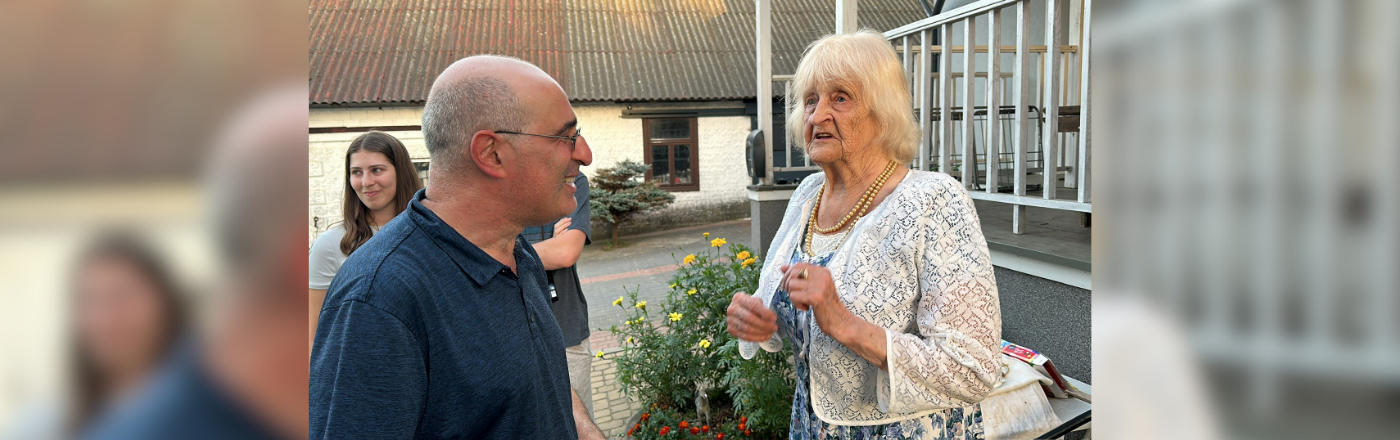
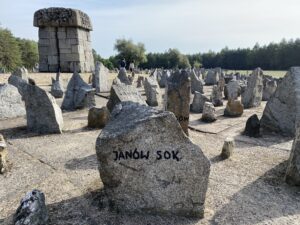
During my visit to Janow in September 2023, I walked the streets where the Jews had lived, the wooden houses long burnt down, together with the magnificent wooden synagogue that once stood in the former Jewish area of the village. Probably it was at that shul where my grandfather had stood at his bar mitzvah, the shul where Mottel and her family prayed on Yom Kippur – where they too bowed down during the Great Aleinu.
The Jewish cemetery today is overgrown. Amidst the grass, there are a few dozen fragments of weathered matzevot (gravestones), on some of which barely legible Hebrew writing can be made out.
After visiting the cemetery, we hear of an older woman whose family had helped Jews from the shtetl during the Shoah. We went to see her, and after a drive through rolling hills, we pulled up to a farm. A wiry woman, Bronislawa, was sitting outside the house in the sunshine. She greeted us with a big smile.
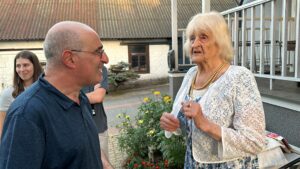
After telling us about the happy time she spent as a nanny with a Jewish family on Long Island many years before, she shared with us the story of a darker chapter of history.
A story hidden for decades emerged. She told of the rounding up of the Jews of Janow on November 2, 1942.
Some Jews escaped, and some of them ended up first with our neighbors and then with us. During the day, they hid in the woods. At night they came to our house … Józef, our neighbor, and my father cooperated all the time in hiding Jews. There was a forest between our farm and theirs, quite a young forest, with two-meter pine trees growing there. Father and Józef dug a ditch there so that the Jews could hide in case of emergency … There were always six or eight of these people. It was very crowded there, but they would stay there all day and come to us at night. The hardest time was in winter, when it snowed, because then the Jews left footprints in the snow. Józef and my father always had to sweep them so that it wouldn’t be visible. You had to take a horse, put on a plough, and ride over these tracks. Another neighbor once came to us and asked my father why he rode his horse in the field in the winter? Father replied that it was because the mare had a foal and it needed to be taught to walk in the field, preferably in winter.
Later, when it became too dangerous, Bronislawa’s father brought the hidden Jews to partisans in the forest. Jews in the forest sometimes survived, many did not.
As I looked through these old letters, bits of paper and photographs preparing for my words today, two questions repeatedly echoed in my mind.
Firstly, might one of those Jews who fled the round-up in Janow and found temporary shelter with Bronislawa’s family have been Mottel or one of the other family members? Could she have been one of those cold hungry Jews who found temporary sanctuary in a desperate effort to survive amidst the horrors of the Shoah, only later to perish? And what can we learn today from Bronislawa, now recognized as a Righteous Rescuer together with and her family, who risked death to carry out a simple act of humanity.
Secondly, what would have happened if that cold uncaring bureaucrat in Ireland had said yes to my grandfather’s pleas to allow her to come? In my mind, Mottel, the cousin I never had, surely would have lived around the corner from my grandparents. She would have had children and grandchildren, a raft of cousins with whom I would have played every weekend. And what does that harsh bureaucratic response to a call for help teach us about the world today?
The story of Mottel and the shtetl of Janow is just one of many fragments and memories of pain and resilience, and of rescue and loss. It’s the story of the Shoah, the story of the Jewish people, the story of Israel.
Today we all think about the hostages dragged from their communities precisely because they live in the Jewish state that was established in order to become a home for those who miraculously survived the Shoah. We pray for פִּדְיוֹן שְׁבוּיִים the redemption of the captives.
May the memory of Mottel, the Jews of Janow, and all those murdered in the Shoah be for a blessing.
G’mar Tov.