A Story of My Family, Found in a Shoebox

Presented on Yom Kippur, 2022/5783
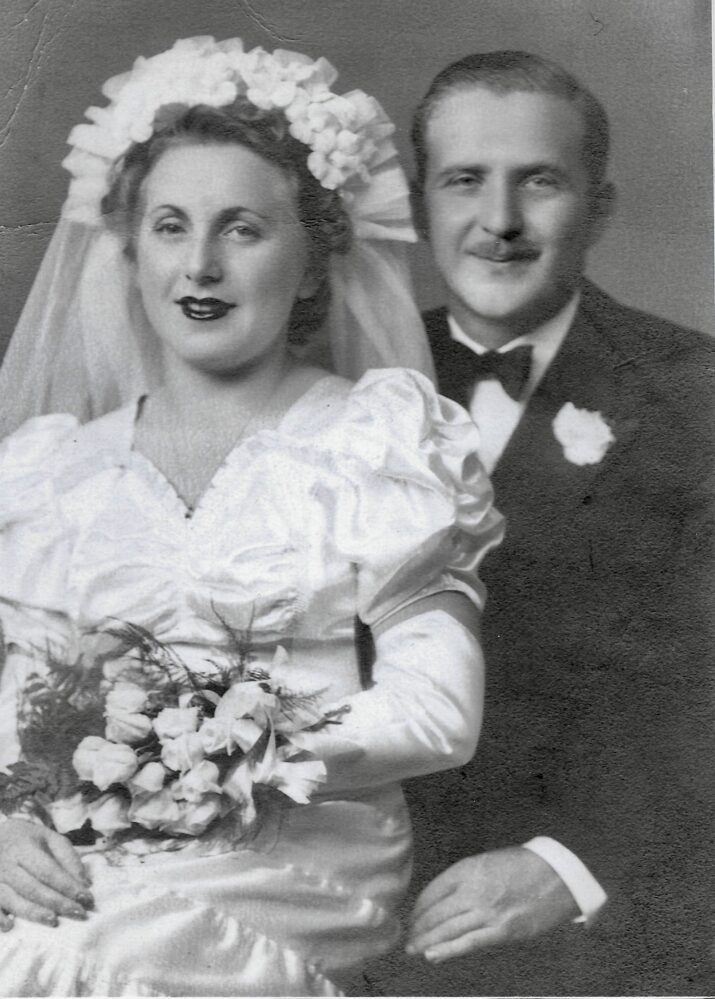
My parents were Viennese Jewish refugees. They came to the United States at the end of 1939. My father, Walter Kohn was 29 years old, and my mother, Dora Korngrün was 19. They met at a Fourth of July party with other Viennese Jewish Refugees in 1940. They married 2 years later and settled in Washington Heights, at that time also known as “Vienna on the Hudson.”
Although both my parents weren’t in concentration camps, from the early 1930’s until the time they fled, they endured years of escalating antisemitism, humiliation, violence, and hardship. My mother had rocks thrown at her every Easter, and she was forced to wear a dunce cap and sit in the corner and called a dirty Jew if the ink had smudged on her paper at school. My father’s family were well-known athletes in the Jewish Sports Club HaKoah, which existed because Jews were not allowed to participate in organized sports with other people.
On March 12, 1938, the Nazis marched into Vienna during the annexation of Austria, known as the Anschluss. The Nazis were welcomed by thousands of cheering people in the streets. My mother ended-up trapped in downtown Vienna amongst the throngs of enthusiastic people yelling “Heil Hitler.” From that day on they couldn’t go to their jobs or attend school. Long-time Christian friends no longer spoke with them. My father left work and returned to his Leopoldstadt neighborhood, where a Nazi soldier forced him to his knees on the cobblestones and, with a gun in his back, made him scrub the street.
When I first told my family story at Yom Kippur in 2016, I didn’t feel the threat to me as a Jew in the United States was imminent. With all the hatred that has been revealed and all the violence perpetrated on Jews in the past few years, the threat of antisemitism feels more palpable, and my family story resonates more profoundly.
Although many members on both sides of my family were murdered, and there are many stories I could tell, today I’m going to focus on the story of my mother’s family, the Korngrüns.
My mother’s family lived in the 19th District in Vienna, called Döbling, in the northern part of the city, near the Vienna Woods. Her parents were Sara and Rudolf Korngrün. Rudolf was a hat salesman, loved opera, music, and books, spoke six languages and was a Zionist. He dreamed of going to Palestine to establish the Jewish states, a place where Jews could have self-determination. My mother, Dora, was born in 1920, and had two younger siblings. At the time of the Annexation of Austria in 1938, my mother was an 18-year-old milliner, her sister Kitty was 16 years old, and her brother Josef was 13 years old.
In the first week of November,1938, just before Kristallnacht, my grandfather, Rudolf, was tipped-off that the Nazis would be arresting Jewish men that night. People in the community were saying that men can find safe haven in Belgium. Rudolf knew of a human trafficker who could take him and two other men across borders and smuggle them into Belgium. He believed that if he could get to Belgium he could work to get the rest of the family out of Austria. The day before Kristallnacht, Rudolf sewed his valuables into his coat lining and prepared to flee. When the Nazis were coming to the door of their apartment building, he ran up to the roof. All the family went up with him to say goodbye. He kissed and hugged them all and jumped to another rooftop and fled into the night. That is the last time his family saw him.
With the trafficker, Rudolf and two other men made the dangerous passage from Austria to Germany and then into the woods on the border of Belgium. There the trafficker robbed them of their money and their papers and left them. They were arrested by border police in Belgium and put into an internment camp for illegal immigrants.
Meanwhile back in Vienna, my mother and her family were forcibly relocated when the Nazis came to the door and told them they had to get out within a few minutes. My grandmother took the white Shabbat tablecloth and put it on the floor and quickly gathered their most precious items and put them in the middle and tied it up. That is all they could take with them. They were sent to live with several other families crowded into an apartment confiscated from the Rothschilds.
My mother’s family had no income and had little money for food. Kitty worked at a Jewish soup kitchen and would bring home leftover food. Disoriented and displaced, they began their desperate attempt to find a way out of Austria. My mother took on the responsibility of seeking means to escape. She spent entire days standing on endless lines at embassies with thousands of other Jews desperately trying to get visas to get out.
Kitty was active in a Zionist youth group, Betar, and in March 1939, she came home one afternoon and told the family that she had the opportunity to escape on a ship to Palestine and she left that same night. My grandmother and mother were able to arrange for Josef to leave on a Kindertransport, a rescue mission that brought Jewish children from Nazi Europe to the United Kingdom (and other countries), where they lived in schools, hostels, farms and with foster families. In May 1939 he went to England where he lived with a foster family.
My mother’s uncle, Harry, who lived in Jersey City since 1920 and owned a candy and liquor store, agreed to send an affidavit of support for my mother to come to the United States, but he could only sponsor one person. It was expensive to be a sponsor, and it was difficult to get a quota number. They believed that if my mother could get to the U.S., she could work and save money to help her parents get out.
With the help of my mother’s uncle and HIAS (Hebrew Immigrant Aid Society) my mother fled Vienna at the end of 1939 and left on a ship from Genoa, Italy. Upon her arrival in Jersey City (10 days later), she had to pay-off her debt to her uncle, the cost of the ship passage and start saving to help her parents. My mother got a job the first day after she arrived at a hat shop on West 38th Street and got to work. My grandmother was left alone in Vienna, and my mother felt guilty about this for the rest of her life.
From the night my grandfather fled Vienna in November 1938 until my mother’s arrival in the United States was only a little more than a year, but in that time the fabric of my mother’s family was torn apart. My grandmother was stuck in Vienna with no income. My grandfather was imprisoned in Belgium. Kitty was alone, living in a tent near Haifa and working on a farm under difficult circumstances. Josef was in England living with strangers. Each of the children were alone in different foreign countries, where they didn’t speak the language. They were homesick, and relying on news and contact from letters that took six months to arrive. They were frightened, but hopeful for a time when they would be together again.
My mother would travel by train to Washington, D.C., and again stand in long lines with thousands of others at all the embassies to try to get visas for her parents. She was refused by country after country. She begged relatives, friends, and acquaintances to sponsor her parents, but individual people either couldn’t afford to help or weren’t willing to take on the responsibility.
In 1941 my mother was able to arrange for my grandmother to get the paperwork to be able to flee Vienna on a train to Lisbon, Portugal, and then board a ship bound for Cuba. That ship was scheduled to depart on October 31, 1941.
(Pause)
Fast forward to the late 1960s. I was a little girl growing up in Teaneck, NJ. My mother had a long narrow walk-in closet. She had been a milliner and a hat designer, and the closet was filled with hat boxes. I loved to play dress-up and put on her hats with feathers and beads. Way-up on the top shelf was a box that I was told never to touch.
When I was a teenager, I asked about the box. My mother sighed, got up on a step stool and took the box down. When she opened it, I saw a faded manila envelope with the words “Briefe von meinen Eltern” (letters from my parents). There were 60 letters. These letters are written in German script on delicate onion skin paper written in ink with blacked-out sections from the Nazi censors, and Swastikas stamped in red. I asked my mother if she would read the letters to me so that I could hear the voices of the grandparents I never knew. She began to read a letter — after 2 sentences she started to weep with such overwhelming grief that we stopped and put them away.
Over the years we would try again and again to read them, but until my mother’s death she could never finish reading a complete letter aloud.
Now the box of letters is in my walk-in closet. When Myriam Abramowicz, who organizes the Eleh Ezkerah speakers, invited me to speak, I told her about the letters that my grandfather had written from four different internment camps in Belgium, and that he had been deported from Malines.
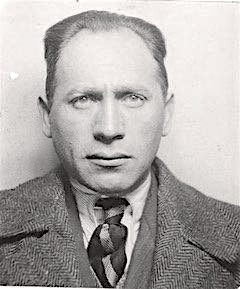
As a documentary filmmaker and historian of the Holocaust, Myriam has a connection to a museum that is on the site of the Malines deportation camp. The museum is called Dossin Kazerne, a Memorial and Documentation Centre on the Holocaust and Human Rights. The day after Myriam put me in touch with the museum, a researcher sent me an email with a photo of my grandfather attached (see photo). This began an email exchange that lasted for many months.
While my mother was never able to finish reading me the letters, over the summer of 2016, the museum at Malines translated the letters for me. The researcher encouraged me to request documents related to my grandfather from the Belgian government. After Yom Kippur 2016 I received 88 pages of documents from the Belgium government which helped me to piece together more of his story. I’ve come to know his experience in his own words from the letters, and more details from his file. Although many questions remain…
Just as my mother experienced, I received these letters slowly, giving me some understanding of the agony and desperation, my mother endured during this time, as she would wait to get word from her parents.
I would like to share some excerpts from my grandfather’s letters:
Dearest Dorli
You can imagine how I felt when I received your last letter from Genoa, for which I thank you wholeheartedly. I had to keep myself together and I will thank the Holy G-d that at least you will get out of here in good health. Again, I have lost hope to see one of my children. This is how one becomes crazy. Everything I love the most and which is holiest to me has been taken from me. I don’t know what is going on with darling mother. I am cut off from everything. But as long as one lives, one shouldn’t give up hope. I have suffered enough. Whether I will bear it, whether I will see you is a big question. Only God knows how this is going to end. Don’t be angry that my first letter contains so many worries
Dear Dora,
It’s unbearable to be imprisoned. I’m a prisoner in jail without having done anything. Some people receive packages with food and cigarettes. Please send me food first. I am writing very poorly today because my hand is shaking. I can’t write often because I don’t have money for stamps. As you know you are so dear to me, but so far away.
Merksplas Kolonie Belgium
13 April 1941
Darling Dorli
Today is your birthday and you are also officially an adult, but I am not there with you. I wish you all the best and all the luck that a father can wish his darling child. You cannot imagine how homesick I am for you. It has been 2-1/2 years already that I haven’t seen you. Only G-d knows why I am here. Hopefully, the war will be over soon, and I will be together with you and all our loved ones. I pray every minute to our dear Lord.
Please write to me soon. I send lots of kisses, especially to you, Your Papa
My grandfather wrote letters to Belgian officials from 1939-1942, for three years, begging to be released from prison so he could go to Palestine or the United States. During those years he was moved around to four different internment camps. At one point he was temporarily released in Brussels and Nazi spies monitored him and eventually arrested him again. They finally released him in the Spring of 1942.
This is an American Red Cross Civilian Message. People were allowed to write no more than 25 words, and only personal or family news. It is the last communication between my mother and her father.
My mother sent it in April1942 and it arrived at the Red Cross Belgium in Brussels in two weeks:
Dear Papa, all children are well. Hope you are well. I am engaged to be married to Walter Kohn. Have you any news of mama? Kisses Doris
My grandfather received it three months later, and sent a response that my mother then received another three months later:
Am well and free in Liege. No news of mother. Congratulations marriage. Kisses Papa.
By the time my mother received this reply 6 months later, my parents were already married, and unbeknownst to my mother, her father had already been murdered. My mother had not heard from her mother for one year, since 1941. At this point all communication with her parents stopped. It was devastating.
My mother wrote letters searching for news of her parents for years. Three years later, in 1945, when my mother was pregnant with my brother, Martin, my mother received a letter from people at my grandfather’s last address in Liege. They wrote that they had not seen him in three years.
In 2007…. 65 years later, we were informed by the American Red Cross Holocaust and War Victims Tracing Center what happened to my mother’s parents.
My grandfather was picked-up on September 24,1942, in Liege and was taken to the Malines Deportation Camp. When they had 1700 people to fill a train, they would deport them. On September 26th on the Transport XI, the train left Malines and arrived in Auschwitz-Birkenau on September 28, 1942. On that day, the 3rd day of Sukkot, my grandfather was murdered. Just six days later, on October 4, 1942, at the end of Simchat Torah, my parents were married. When we found this out in 2007, it weighed heavily on my mother.
Just before my grandmother was scheduled to escape Vienna, in October 1941 and board the ship to Cuba, she was rounded-up and detained in what was called a collection camp in the Jewish district of Vienna in a primary school, the Kleine Sperlgasse 2A. Coincidentally was where my father had gone to primary school. Two thousand Jews were there awaiting deportation and slept on the floor on straw like barn animals. The conditions were terribly unsanitary and difficult there; many people committed suicide there. On November 23rd 1941, my grandmother was deported on a transport to Fort IX in Kaunas, Lithuania. Upon arrival, she were stripped naked and shot into a pit with 1,154 other women, 693 men and 152 children on November 29, 1941. In the month of November 1941 alone there were 5,000 Jews murdered at Fort IX.
My mother lived with not knowing her parents’ fate for more than 60 years. Since reading these letters I have a deeper understanding of the heartache, and all the emotions that my mother carried during her entire life. Her resilience continues to inspire me. Even after all that she endured she was kind, generous, loving and always looked forward. My mother and father, aunt and uncle went on to have long and loving marriages, children, and grandchildren and now there are great-grandchildren. They created meaningful and happy lives in the U.S. and in Israel.
The researcher from the museum told me that letters like these are extremely rare. I donated the letters to the museum in my mother’s family’s honor.
In September 2019, The Parliament of the Republic of Austria approved an amendment to offer citizenship to descendants of those persecuted in the Holocaust. I was ambivalent about applying, and I know my parents would not have approved. However, considering the recent events in the U.S., I decided to pursue dual citizenship. In Spring 2022, I was granted an Austrian passport. When the Consular Officer called to congratulate me, I spoke openly with her about my mixed feelings and told her some of my family history. She told me how meaningful it was for her to hear the stories and how honored she felt to return something to me that had been stolen from me, and was rightfully mine. She felt honored to participate in an act of reconciliation with families of those who suffered.
Unfortunately, today there are 68 million refugees around the world and the number is only going to get larger. There are millions of stories of flight, separation, fear, and sorrow that go unheard. Millions whose cries for help go unanswered. We tell our Shoah stories so that this catastrophe will not be forgotten. Unfortunately, the world has not learned from the tragedy that befell our people and we are all too aware that other groups are also suffering, and still antisemitism lives on and is growing.
I’m grateful to be part of a community that commits itself to welcome the stranger and to not turn away from what is difficult, and in fact, has an active refugee committee that has committed to sponsor a family from Guatemala for their first year and cares for immigrant families.
I’d like to thank the Rabbis and Myriam Abramowicz for the opportunity to speak about my family and share part of their story with you today.
I am grateful to many friends and BJ members who presented Eleh Ezkerah in the past, and their support and friendship. I wish them and you, all the BJ community, a G’mar Hatimah Tovah.
Sherry Kohn has been a member of BJ since 1992. She is a nurse practitioner at the Hospital for Special Surgery and lives in Manhattan.